Intelligent Planning of Ocean Energy Infrastructure: A Synergistic Mechanism between Ecological Protection and Energy Development
Keywords:
Ocean Energy Infrastructure, Marine Spatial Planning, Ecological Sensitivity, GIS-MCDM, Scenario Simulation, Life-Cycle PressureAbstract
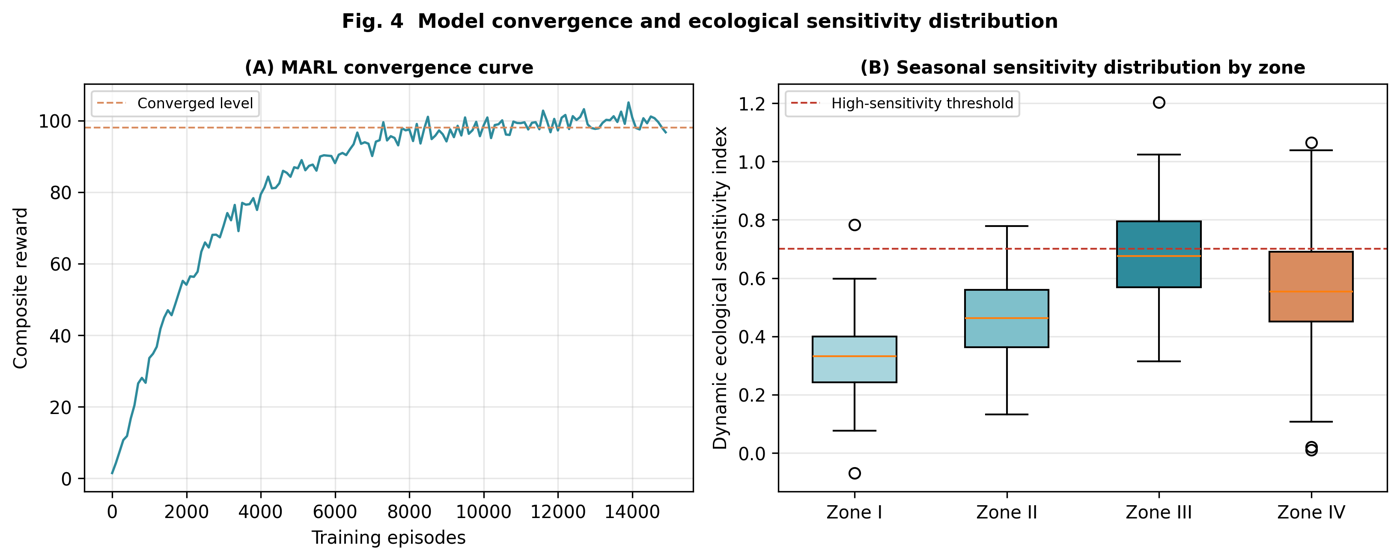
With the rapid expansion of offshore wind and other ocean energy facilities, conflicts between energy development and ecologically sensitive marine areas have become increasingly prominent. Existing marine spatial planning approaches often rely on static exclusion zones and linear weighting methods, which may not sufficiently reflect seasonal ecological sensitivity and life-cycle environmental pressures. To address this problem, this study develops a GIS-based scenario planning framework that combines ecological sensitivity assessment, life-cycle pressure estimation, and multi-criteria spatial suitability analysis. Publicly available marine environmental, biodiversity, energy-resource, and spatial constraint datasets were integrated for representative areas in the European North Sea and the East China Sea. The framework compares a conventional static planning scenario with an ecological-sensitivity-constrained planning scenario. Simulation results indicate that incorporating seasonal ecological sensitivity and decommissioning-related pressure can substantially reduce infrastructure occupation in high-sensitivity zones while maintaining most of the energy development potential. The proposed framework does not aim to replace site-specific environmental impact assessment; rather, it provides a transparent screening and decision-support tool for early-stage marine spatial planning. The results suggest that ecological protection and energy development can be better coordinated when dynamic ecological constraints and life-cycle considerations are incorporated into spatial planning.