From Ecological Restoration to Social–Ecological Resilience: Collaborative Governance Mechanisms among Multiple Stakeholders in Mangrove Conservation
Keywords:
Mangrove conservation, collaborative governance, social–ecological resilience, ecological restoration, blue carbonAbstract
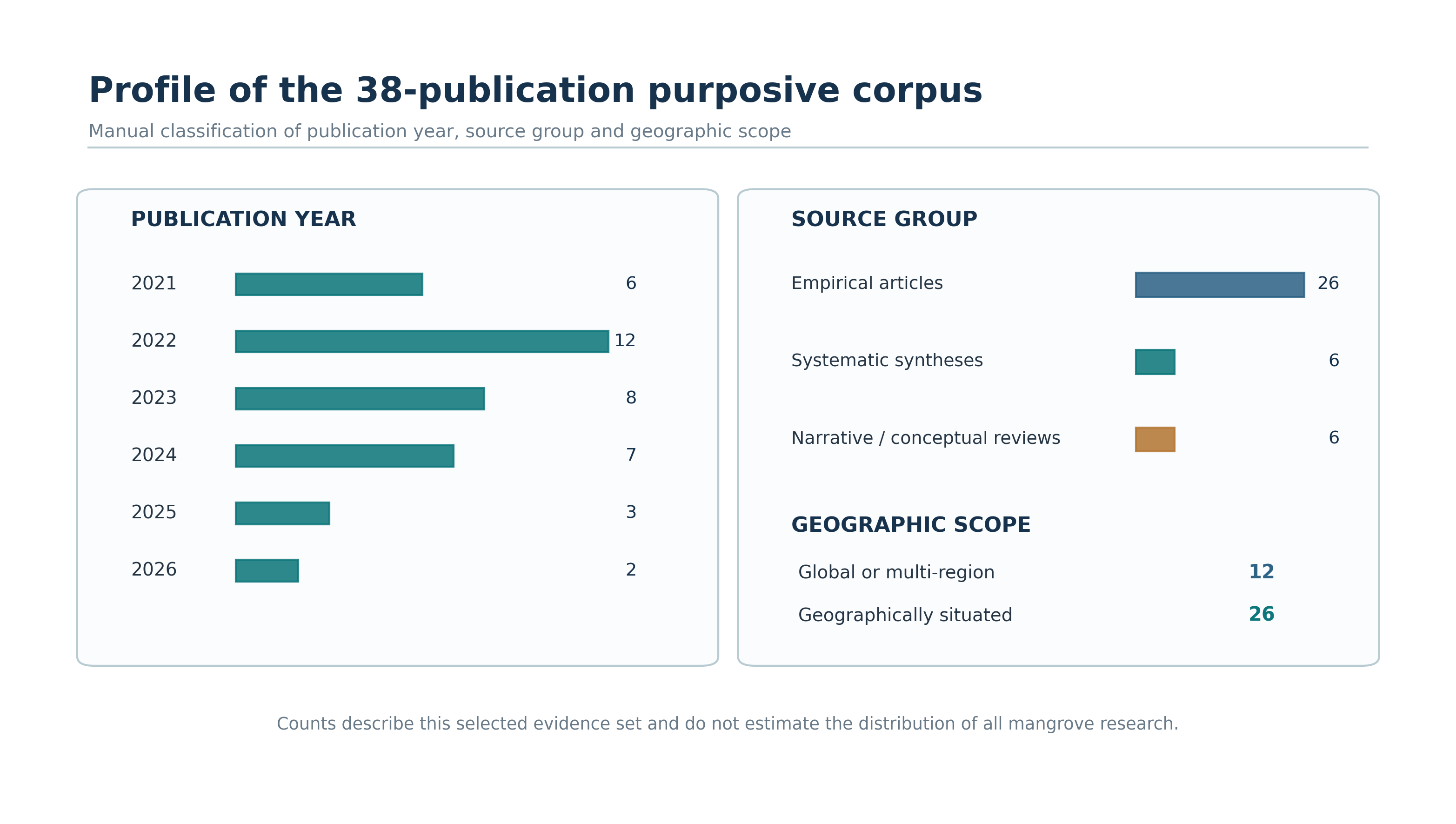
Mangrove restoration is increasingly expected to support biodiversity, livelihoods, carbon management and coastal protection. Yet restoration interventions are often assessed as ecological projects rather than as arrangements through which actors allocate authority, knowledge, risks and benefits. This separation obscures why technically plausible interventions may not persist, adapt to disturbance or distribute gains fairly. This structured evidence synthesis addresses that gap by examining how collaborative governance mechanisms connect mangrove conservation and restoration to social–ecological resilience. A structured, purposive search across six thematic domains assembled 38 peer-reviewed sources published in 2021–2026. Records were screened and checked manually for duplicate titles and identifiers, then coded by hand for stakeholder categories, seven governance mechanisms and five resilience dimensions. Simple counts and a qualitative comparison of coded categories describe patterns in this purposive corpus. Adaptive monitoring and learning occurs in 14 records (36.8%) and nested cross-scale coordination in 10 (26.3%), while knowledge co-production occurs in four (10.5%). Manual comparison suggests that rights and tenure recognition is frequently discussed with equity and justice, while nested cross-scale coordination is frequently discussed with adaptive capacity. These are descriptive observations obtained from a manually coded literature corpus, not population estimates, statistical associations or causal effects; further quantitative analysis can be carried out in future research. The synthesis advances a mechanism-based framework in which participation, rights, knowledge, learning, finance, cross-scale coordination and accountable conflict resolution jointly create legitimacy, trust, learning, resource mobilization, compliance and institutional fit. It thereby shifts attention from planting outputs towards the governance capacities needed to sustain ecological function, livelihood security, equity, coastal-risk reduction and adaptive capacity.