From Energy Crops to Carbon-Negative Biomanufacturing: An Integrated Strategy for Plant Carbon Capture, Storage, and Conversion
Keywords:
carbon-negative biomanufacturing, lignocellulosic feedstock, carbon partitioning, biochar, durable carbon storage, plant synthetic biology, techno-economic assessmentAbstract
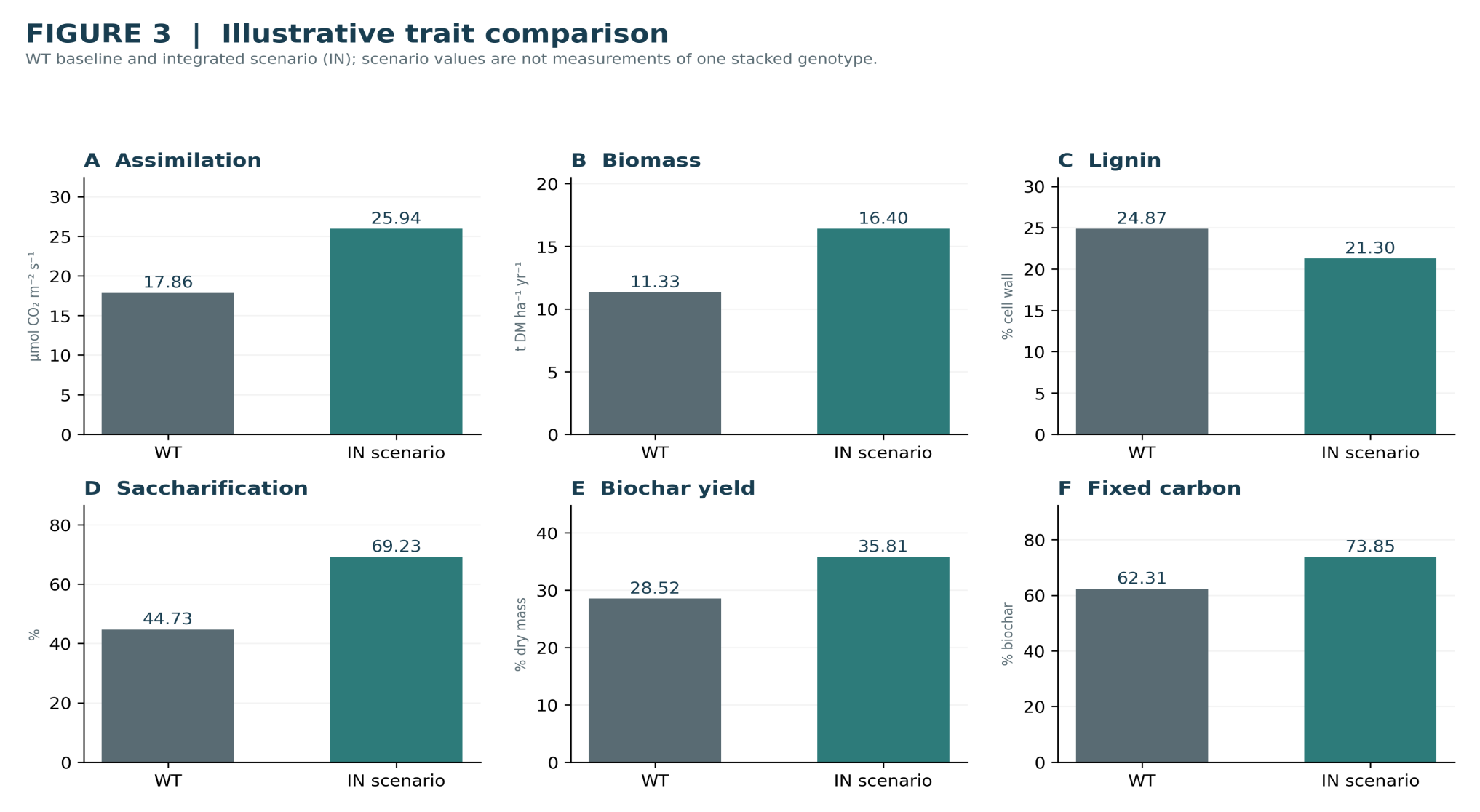
Carbon dioxide removal at the scale implied by net-zero pathways requires terrestrial systems that do more than produce combustible biomass. Conventional energy crops convert photosynthetic carbon into a single, short-lived product stream, and their carbon-removal efficiency is constrained by three bottlenecks: limited photosynthetic carbon gain, losses during biomass conversion and decomposition, and the low economic value of bulk energy carriers. Here we examine whether these bottlenecks can be addressed together by linking carbon capture, durable storage and material conversion in a lignocellulosic feedstock framework. Feasible single-gene modification or conventional overexpression, a small pot experiment and a limited field pilot provide a practical route for assessing selected individual traits; simultaneous four-module integration remains a prospective design. Illustrative trait ranges for the integrated scenario, derived from small-scale measurements described in the study framework and published literature parameters, include light-saturated assimilation of 25.94 versus 17.86 µmol CO₂ m⁻² s⁻¹, biomass of 16.40 versus 11.33 t DM ha⁻¹ yr⁻¹, an S/G ratio of 2.23 versus 1.40, saccharification of 69.2% versus 44.7%, biochar yield of 35.8% versus 28.5%, and fixed carbon of 73.9% versus 62.3%. A simple mass balance and first-order decay calculation projects net removal of 4.45 versus 1.29 t CO₂e ha⁻¹ yr⁻¹ and efficiencies of 16.2% versus 6.0% under the stated illustrative assumptions. These are scenario outputs, not measurements of a stacked genotype or a multi-environment trial. Biochar carbon retention and biomass supply govern the scenario result, but the predicted synergy and long-term removal require future experimental verification.