Information-Theoretic and Machine-Learning Fusion for Resilience Identification and Critical-Transition Early Warning in Population Dynamical Systems
Keywords:
cpopulation resilience, early-warning signals, Fisher information, permutation entropy, machine learning, critical transitionsAbstract
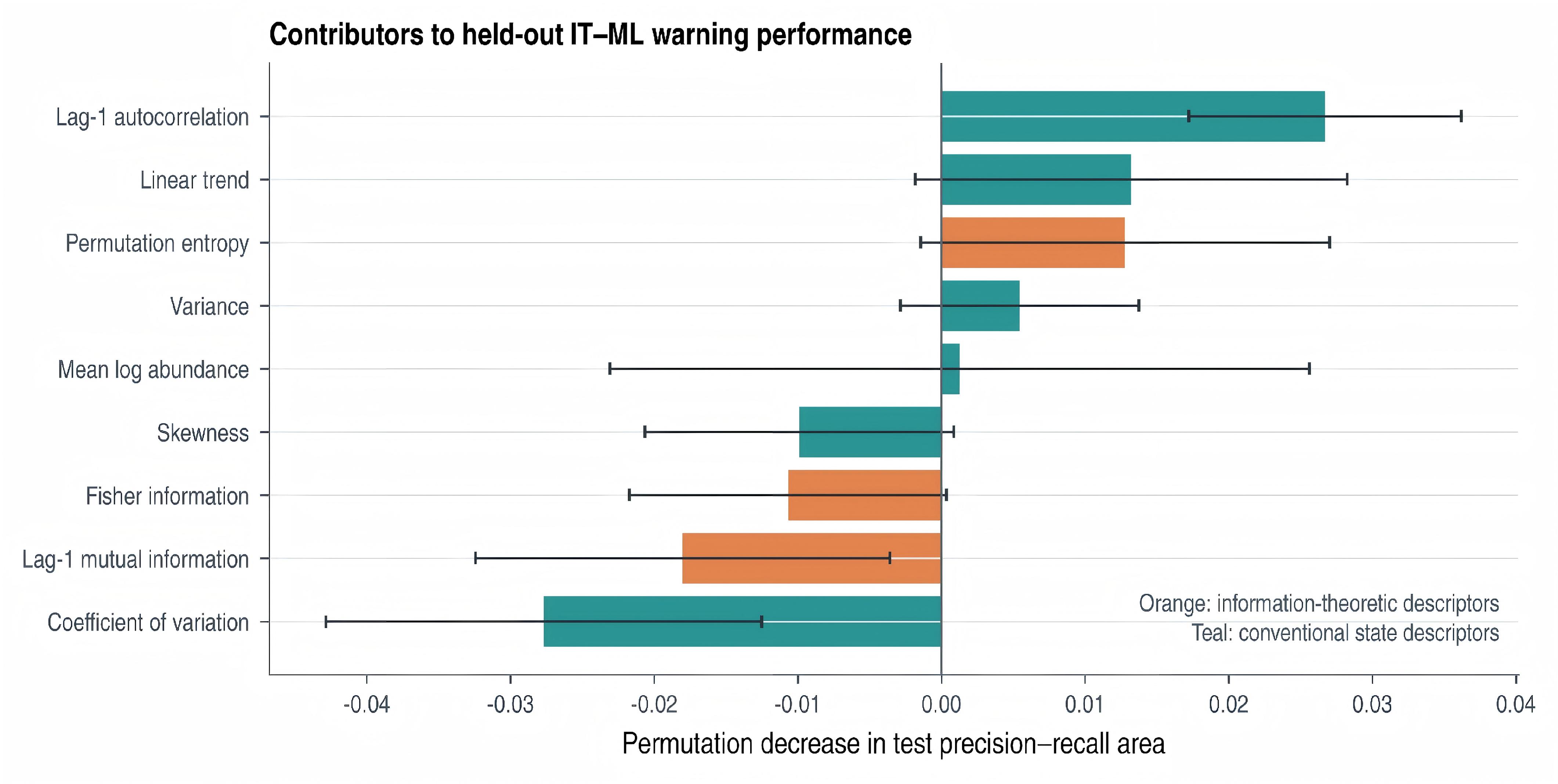
Resilience monitoring in population systems is increasingly constrained by irregular sampling, seasonal forcing, and the limited transferability of generic early-warning signals. This study develops an information-theoretic and machine-learning (IT–ML) framework that treats resilience assessment as a prospective decline-risk problem rather than as an assertion that every observed downturn is a bifurcation. The framework integrates Fisher information, permutation entropy, and lag-one mutual information with conventional rolling descriptors of abundance dynamics, and evaluates their combined utility under chronology-respecting validation. A reproducible empirical benchmark was constructed from publicly available Portal Project rodent records. The analysis retained six target species, 186 census periods, and 1,116 effort-standardized species–census observations from 1999 to 2015. A sharp-decline outcome was defined prospectively as a mean abundance during the next three censuses that was at most 55% of the preceding six-census mean, conditional on a preceding mean of at least two individuals. The held-out test period contained 246 evaluation windows and 31 prospective decline events. A conventional early-warning composite achieved a receiver operating characteristic area under the curve (ROC-AUC) of 0.649. A machine-learning model based on conventional temporal statistics achieved ROC-AUC 0.703, whereas the IT–ML fusion achieved ROC-AUC 0.648 and precision–recall area 0.178. Species-block bootstrap intervals were broad, and the information features did not add a stable aggregate gain beyond autocorrelation and local trend. These results show that information-theoretic descriptors can be incorporated transparently into population-monitoring pipelines, but their operational value is context dependent. The principal contribution is therefore an auditable workflow that separates resilience-relevant state description, prospective warning, and causal claims about critical transitions.