A Practice-Based Study on Deformable Matter Design Based on Four-Dimensional Composition: A Spatio-Temporal Coupling Perspective on Intelligent Interactive System Development
Keywords:
Four-Dimensional Composition,Morphing Matter,Spatio-Temporal Coupling Design,4D Printing,Intelligent Interactive SystemsAbstract
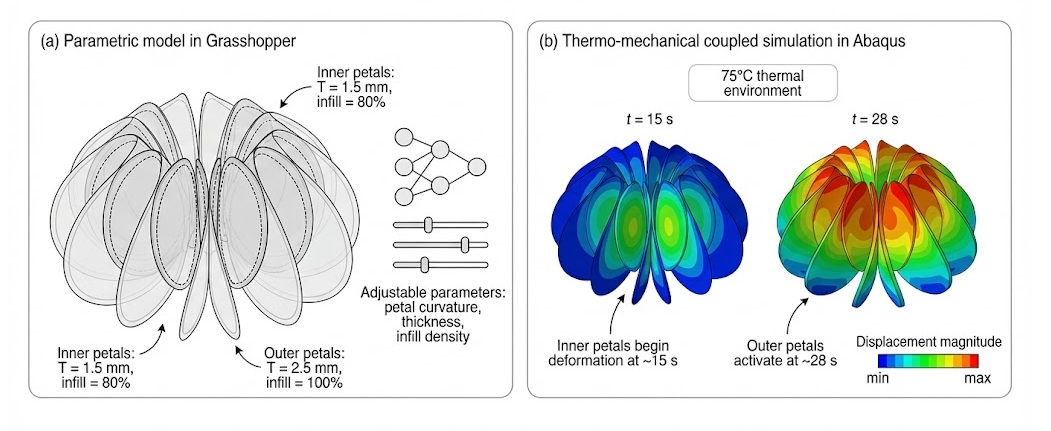
With the rapid development of smart materials and digital fabrication technologies, morphing matter—materials capable of changing their shape and function in response to external stimuli—has shown great potential in areas such as intelligent interaction, soft robotics, and kinetic architecture. Despite this promise, most current design approaches for deformable matter remain heavily engineering-oriented, relying on optimization techniques or trial-and-error experimentation. As a result, they lack a systematic, design-driven theoretical framework that supports creative innovation. In particular, there is a notable research gap in methods that can effectively integrate spatial form with temporal behavior.To address this challenge, this study introduces the concept of “Four-Dimensional (4D) Composition” (three-dimensional space plus one-dimensional time), derived from fundamental design theory, as a new framework for developing spatio-temporal coupling strategies in deformable matter design. Using thermo-responsive Shape Memory Polymers (SMPs) as the primary material and 4D printing as the fabrication method, the research systematically investigates the relationship between spatial structural parameters and time-dependent deformation behaviors through parametric modeling.Based on this approach, an intelligent interactive lighting prototype called Dynamic Rhythm was designed and fabricated. Experimental evaluations demonstrate that the prototype can achieve pre-programmed dynamic deformation with an accuracy exceeding 95%, a response time of less than 30 seconds, and stable performance across more than 100 actuation cycles. These results confirm the reliability and repeatability of the proposed design method.Overall, this study concludes that 4D Composition provides a clear logical structure and an effective design pathway for deformable matter. By employing parametric, spatio-temporal coupling strategies, it enables precise control over complex dynamic behaviors. Beyond offering a new theoretical perspective and systematic methodology, this research also expands the possibilities for morphological innovation and experiential design in future intelligent interactive systems.