A Health-Enhancing Design Framework: Ecological-Enabling Product and Environmental Design Strategies for Sedentary Populations
Keywords:
Health-Enhancing Design, Sedentary Behavior, Affordance Theory, Ecological Enablement, Product-Environment Systems, Design StrategyAbstract
Background: As digitally enabled and “smart” workplace settings become increasingly common, prolonged sitting in offices has evolved into a worldwide public-health issue. Sustained sedentary exposure is associated with markedly higher probabilities of cardiovascular disease, metabolic syndrome, and increased all-cause mortality. Although many organizations have introduced countermeasures—such as wellness seminars, periodic health education, or the provision of single-purpose exercise devices—these efforts frequently show weak durability over time. A major limitation is that such interventions are often separated from everyday work practices and do not adequately account for the continuously shifting person–environment relationship that shapes behavior in real contexts. Accordingly, current research still lacks a systematic approach for coupling products with environmental features to establish an integrated, ecology-based health-support system.
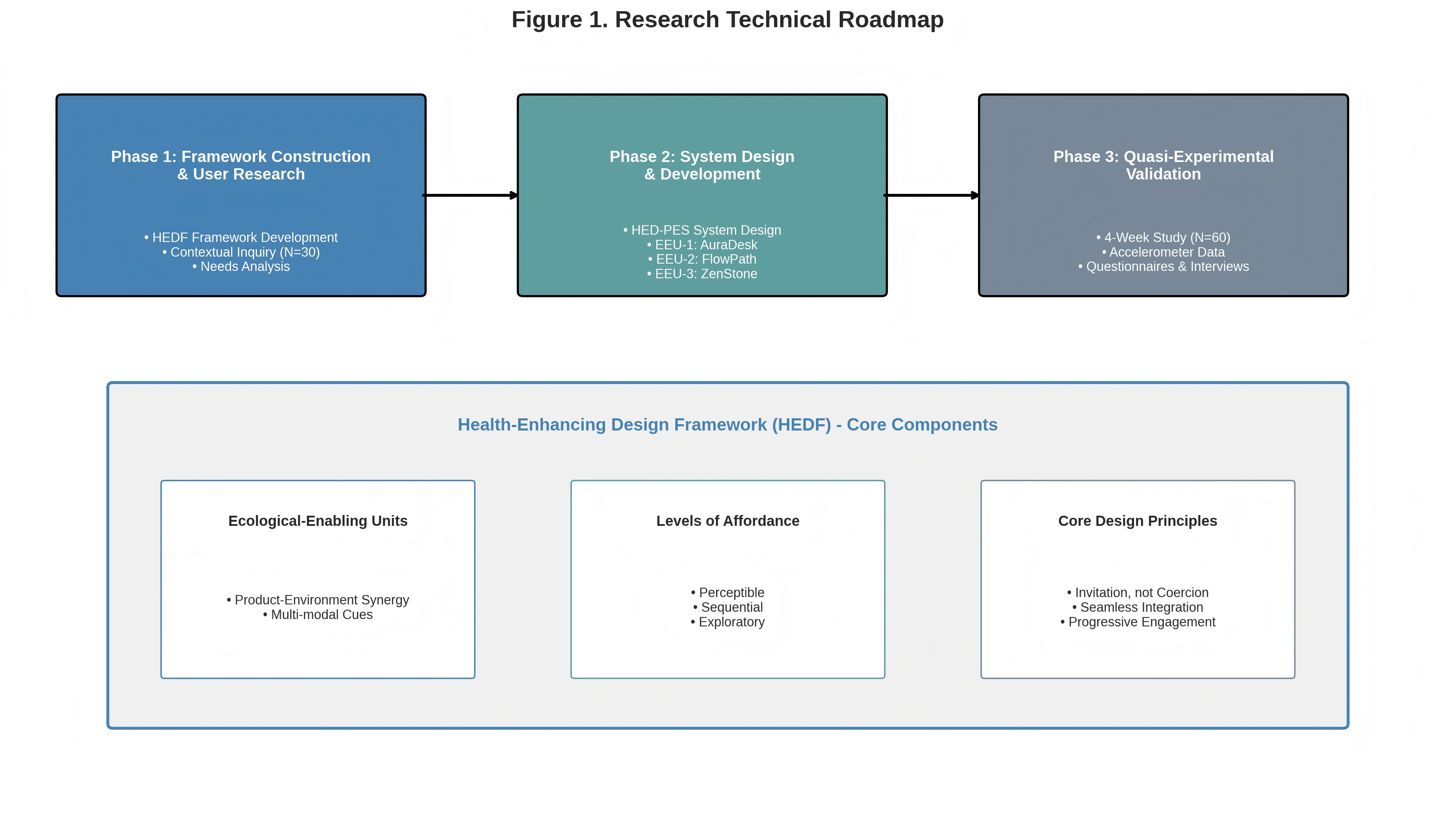
Methods: To respond to this research gap, the present study develops a Health-Enhancing Design Framework (HEDF) grounded in ecological psychology, with Affordance Theory as its primary conceptual foundation. Instead of relying on external pressure or explicit enforcement, the framework is designed to prompt and invite movement in a natural manner during routine office activities. This objective is achieved by defining and designing Ecological-Enabling Units (EEUs)—coordinated assemblages of product attributes and environmental signals that operate synergistically to encourage activity with minimal disruption to work.
Implementation: A mixed-methods strategy was adopted to validate both the framework and its practical application. First, contextual inquiry combined with direct observation was conducted to examine behavioral routines, constraints, and health-related needs among 30 sedentary office employees. Second, following HEDF guidance, an ecological-enabling product–environment system (HED-PES) was designed and prototyped, consisting of a smart sit–stand workstation, floor-level visual guidance elements, and a desktop micro-interaction object intended to trigger subtle, low-effort movement opportunities. Third, a four-week pragmatic, parallel-group randomized trial (N = 60) was implemented in an operational office environment. Because blinding is inherently difficult for interventions that modify both products and surroundings, masking was not implemented; therefore, the evaluation emphasized objective accelerometer-derived metrics, collected under standardized protocols during defined work-hour periods.
Results: The findings indicate that the intervention developed under HEDF principles produced robust and statistically significant benefits. Relative to baseline, the experimental group demonstrated a 75.3-minute decrease in average daily total sedentary duration (p < 0.001), a 48.5% increase in the frequency of sedentary interruptions (p < 0.01), and a 60.8-minute increase in light physical activity (LPA) time (p < 0.001). Qualitative feedback further suggested that, by embedding prompts and action opportunities directly into the workflow, the system reduced the cognitive effort required for behavior change while strengthening intrinsic motivation and perceived health self-efficacy.
Conclusion: The proposed Health-Enhancing Design Framework (HEDF) provides a structured and context-sensitive design paradigm for mitigating sedentary behavior in office environments. Rather than treating products or spatial modifications as isolated solutions, the framework emphasizes designing for an enabling feedback loop between individuals and their surroundings, thereby supporting sustained behavior change through everyday affordances. In doing so, HEDF offers designers, organizational leaders, and public-health decision-makers a theoretically grounded and practically actionable toolset for developing scalable, durable workplace health-promotion strategies.