Intelligent Energy Scheduling Optimization: Design of Distributed Energy Systems for Mixed-Use Communities Driven by Dynamic Tariffs
Keywords:
Distributed Energy System (DES), Mixed-Use Community, Intelligent Scheduling, Deep Reinforcement Learning (DRL), Dynamic Tariffs, Payback Period, Energy Optimization.Abstract
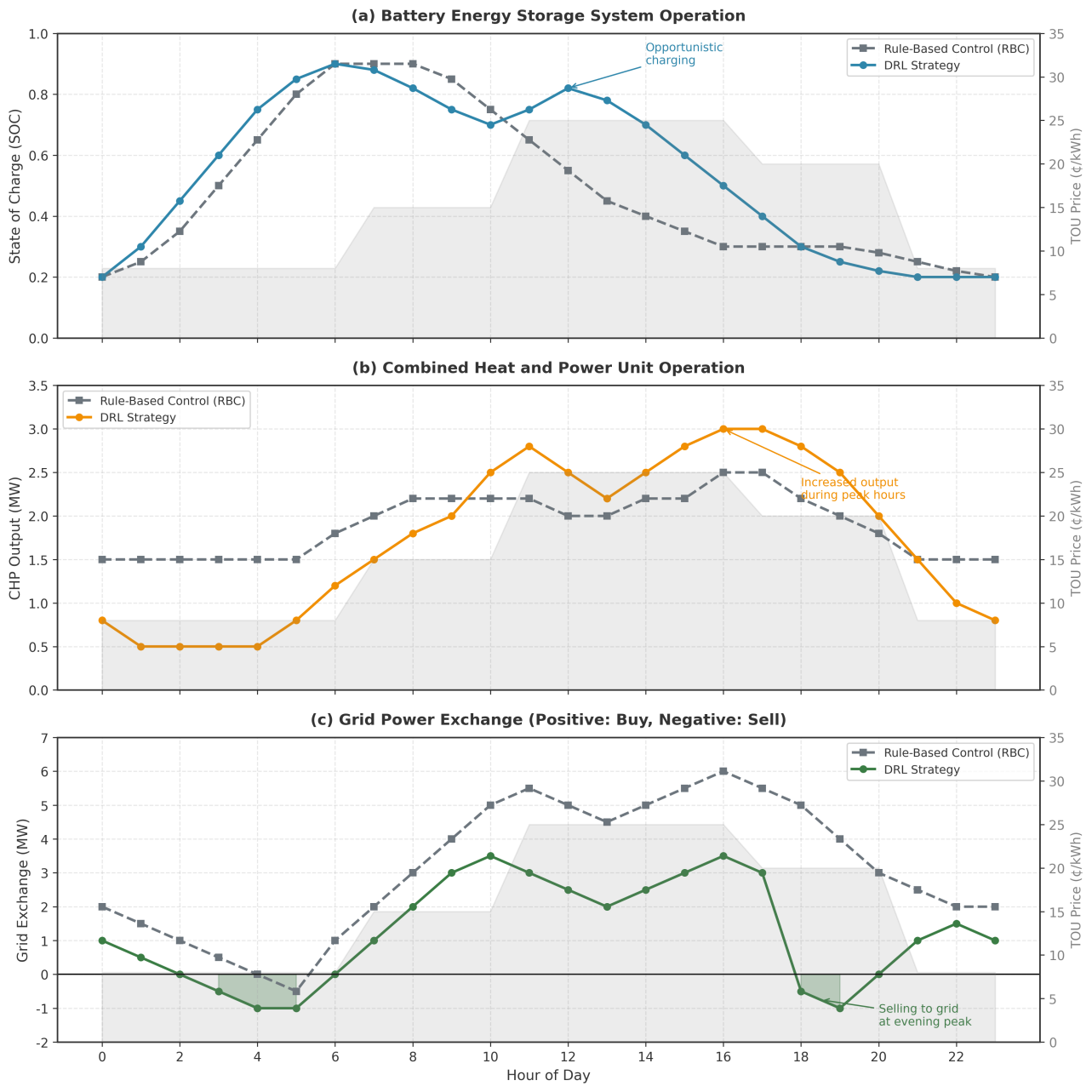
The increasing integration of renewable energy sources and the growing complexity of urban energy demands necessitate a paradigm shift from passive consumption to active, intelligent energy management. This paper presents a comprehensive framework for the optimal design and scheduling of a Distributed Energy System (DES) within a mixed-use community, driven by dynamic electricity tariffs. The core of this framework is a novel intelligent scheduling algorithm based on Deep Reinforcement Learning (DRL), specifically the Deep Deterministic Policy Gradient (DDPG) algorithm. We formulate the energy scheduling problem as a Markov Decision Process (MDP), where the DRL agent learns a control policy to minimize the long-term economic costs, directly targeting the reduction of the project’s Payback Period (PBY). A detailed simulation environment is developed, modeling a mixed-use community with diverse load profiles (residential, commercial, public) and a DES comprising photovoltaic (PV) panels, wind turbines (WT), a Battery Energy Storage System (BESS), and a Combined Heat and Power (CHP) unit. We evaluate the performance of the DRL-based strategy against a conventional Rule-Based Control (RBC) strategy under four different dynamic tariff structures: Fixed Rate, Time-of-Use (TOU), Logarithmic, and Exponential. The results demonstrate that the DRL agent significantly outperforms the RBC strategy across all scenarios, reducing the annual operating cost by up to 19.7% and shortening the investment payback period by as much as 2.5 years. The study highlights the synergistic effect between advanced control algorithms and dynamic market signals, providing a robust methodology for enhancing the economic viability and operational efficiency of community-scale energy systems, thereby promoting sustainable urban development.