An Innovative Circular Product Design Process and Methodology under Closed-Loop Supply Chain Constraints
Keywords:
Closed-Loop Supply Chain (CLSC); Circular Product Design; Circular Economy; Remanufacturing; Sustainable DesignAbstract
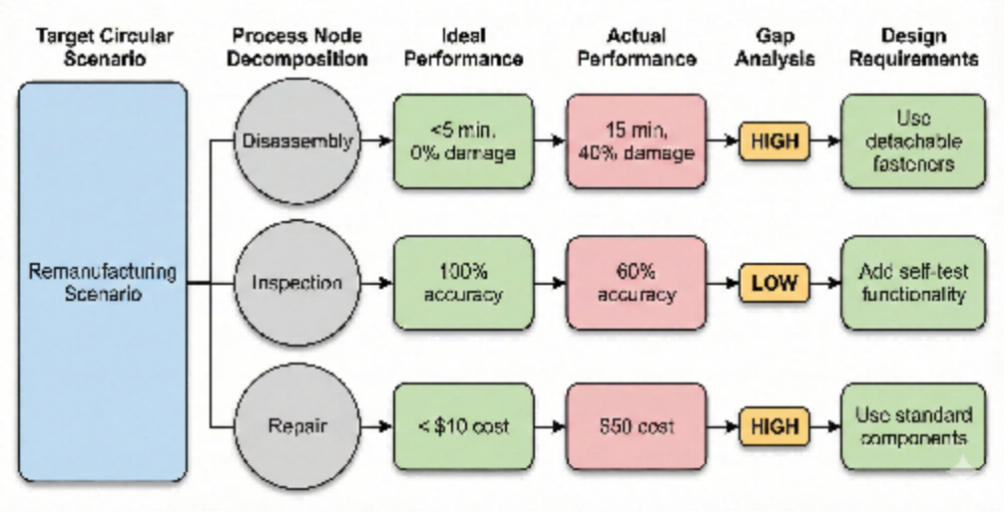
As the circular economy continues to reshape global manufacturing, the electronics industry finds itself at a critical turning point. The traditional linear model—produce, use, discard—is increasingly unsustainable, both economically and environmentally. At the same time, the shift toward closed-loop systems presents new opportunities for value creation. Yet a persistent gap remains: most product design methods are still disconnected from end-of-life (EoL) processes such as collection, remanufacturing, and recycling. This disconnect leads to inefficient material recovery, high remanufacturing costs, and significant losses in potential circular value. To address this challenge, this study seeks to bridge product design and supply chain management. Grounded in the principles of Business Process Re-engineering (BPR), it proposes an innovative framework: the Circular Product Design Process under Closed-Loop Supply Chain Constraints (CPDP-CLSC). The core idea is to bring supply chain considerations—traditionally addressed downstream—directly into the front end of design decision-making. Using a smartphone as a case study, the research demonstrates how key supply chain factors—such as collection rates, remanufacturing costs, and residual material value—can be translated into explicit design parameters and optimization objectives. Instead of treating circularity as an afterthought, the method embeds it structurally into the product development process. The proposed CPDP-CLSC framework consists of five interconnected phases: Circular Scenario Definition – Identifying potential recovery pathways and mapping value flows within a closed-loop supply chain context. Recyclability Requirement Analysis – Converting supply chain constraints and recovery targets into measurable design requirements. Multi-Life Function and Structure Design – Developing modular architectures and component strategies that support reuse, repair, and remanufacturing across multiple life cycles. Circular Value Assessment and Optimization – Applying analytical models to evaluate trade-offs and maximize overall circular value. Material and Process Selection – Choosing materials and manufacturing processes that enhance recoverability while maintaining performance and cost competitiveness. The smartphone case study highlights the practical impact of this approach. A new-generation design developed under the CPDP-CLSC framework demonstrated significant improvements in modularity, ease of disassembly, and reusability of key components. Model-based evaluation results showed a 40% reduction in disassembly time, a 25% decrease in remanufacturing costs for core modules, and a 15% increase in overall circular value. These improvements illustrate how aligning design decisions with closed-loop supply chain constraints can unlock both environmental and economic benefits. Beyond the specific case, this research contributes a systematic and operational methodology for circular product design. Theoretically, it advances the integration of supply chain thinking into early-stage design, strengthening the connection between circular economy principles and engineering practice. Practically, it provides electronics manufacturers with a structured pathway to enhance resource efficiency, reduce lifecycle costs, and build sustainable competitive advantages in an increasingly regulation-driven and sustainability-conscious market. By embedding circularity into the DNA of product development, this framework offers meaningful support for the broader green transformation of manufacturing.