Interpretable Generative Model-Driven Inverse Design of Catalytic Materials: From Candidate Generation to Mechanism Verification
Keywords:
Interpretable Machine Learning, Generative Models, Inverse Design, Electrocatalysis, CO₂ ReductionAbstract
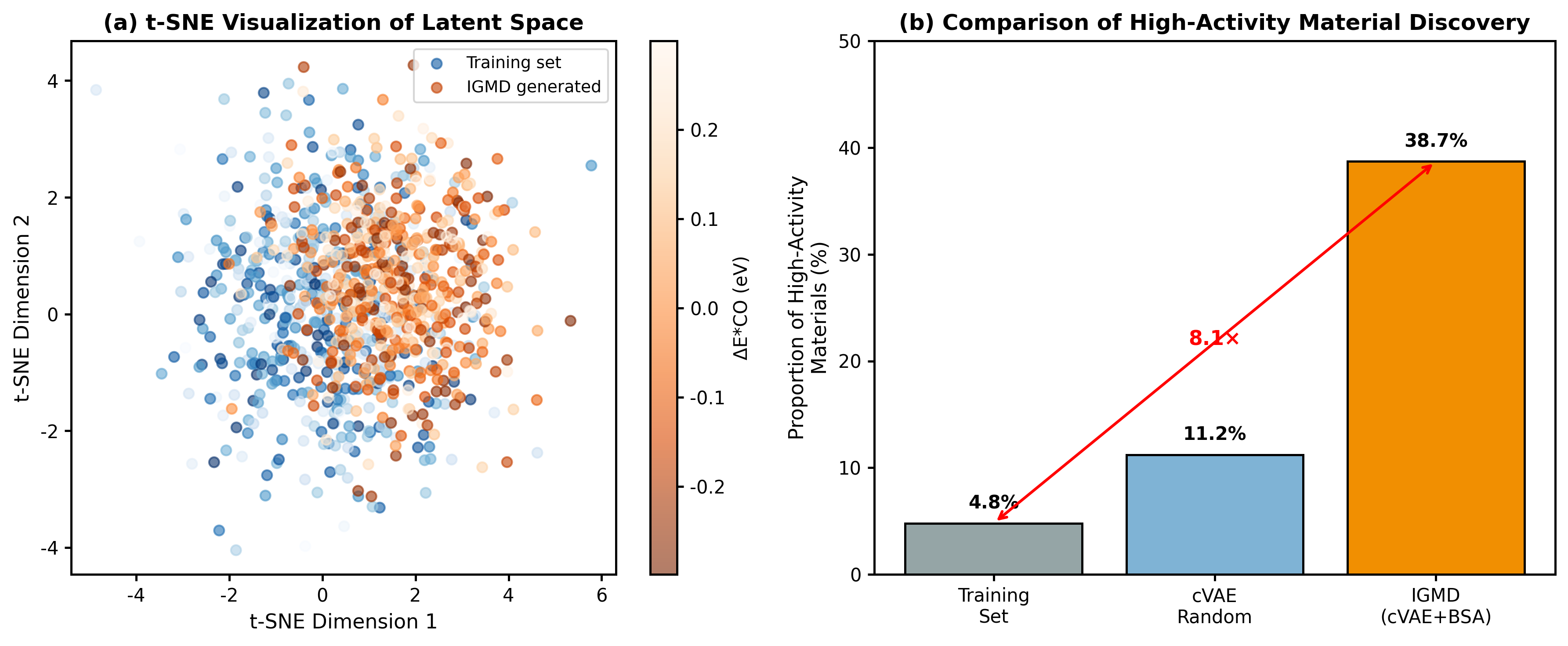
The discovery and design of catalytic materials are central challenges in achieving sustainable chemical production and energy transition. Traditional trial-and-error experimentation and forward computational screening methods, based on existing structural prototypes, face inherent limitations in efficiently and innovatively exploring the vast chemical space. Inverse design, which generates novel material structures directly from target properties, offers a revolutionary approach to overcome this bottleneck. However, its development has long been hampered by the "black-box" nature of generative models and a disconnection from physical mechanism validation. This paper proposes a new framework named "Interpretable Generative Model-Driven Inverse Design" (IGMD), which deeply integrates a Conditional Variational Autoencoder (cVAE) for target-oriented candidate structure generation, SHAP (SHapley Additive exPlanations)-based interpretability analysis for extracting physically meaningful design rules, and Density Functional Theory (DFT) calculations for high-fidelity catalytic mechanism verification. Applied to the CO₂ reduction reaction (CO₂RR), the IGMD framework generated a large number of novel alloy catalyst candidates, among which the top 100 candidates were selected for high-fidelity DFT verification, leading to a notable increase in the proportion of high-potential catalytic materials compared to the original training set. Three novel bimetallic catalysts (e.g., Cu-Al, Ag-In) screened and synthesized through this framework exhibited excellent catalytic performance in experimental tests, with the Ag-In catalyst achieving a Faradaic efficiency exceeding 92% for the target product CO. This study not only demonstrates the immense potential of the IGMD framework in accelerating the discovery of high-performance catalytic materials but, more importantly, establishes a complete closed loop from data-driven candidate generation and interpretable physical law mining to first-principles mechanism verification, providing a new paradigm for automated and trustworthy catalytic material design.