Sustainable Tourist Trip Design Problem under Dual Constraints of Carbon Emission and Ecological Footprint: A Novel Framework Based on an Improved Multi-Objective Evolutionary Algorithm
Keywords:
Sustainable Tourism, Tourist Trip Design Problem (TTDP), Carbon Emission Constraint, Ecological Footprint, Multi-Objective Optimization, Improved NSGA-II AlgorithmAbstract
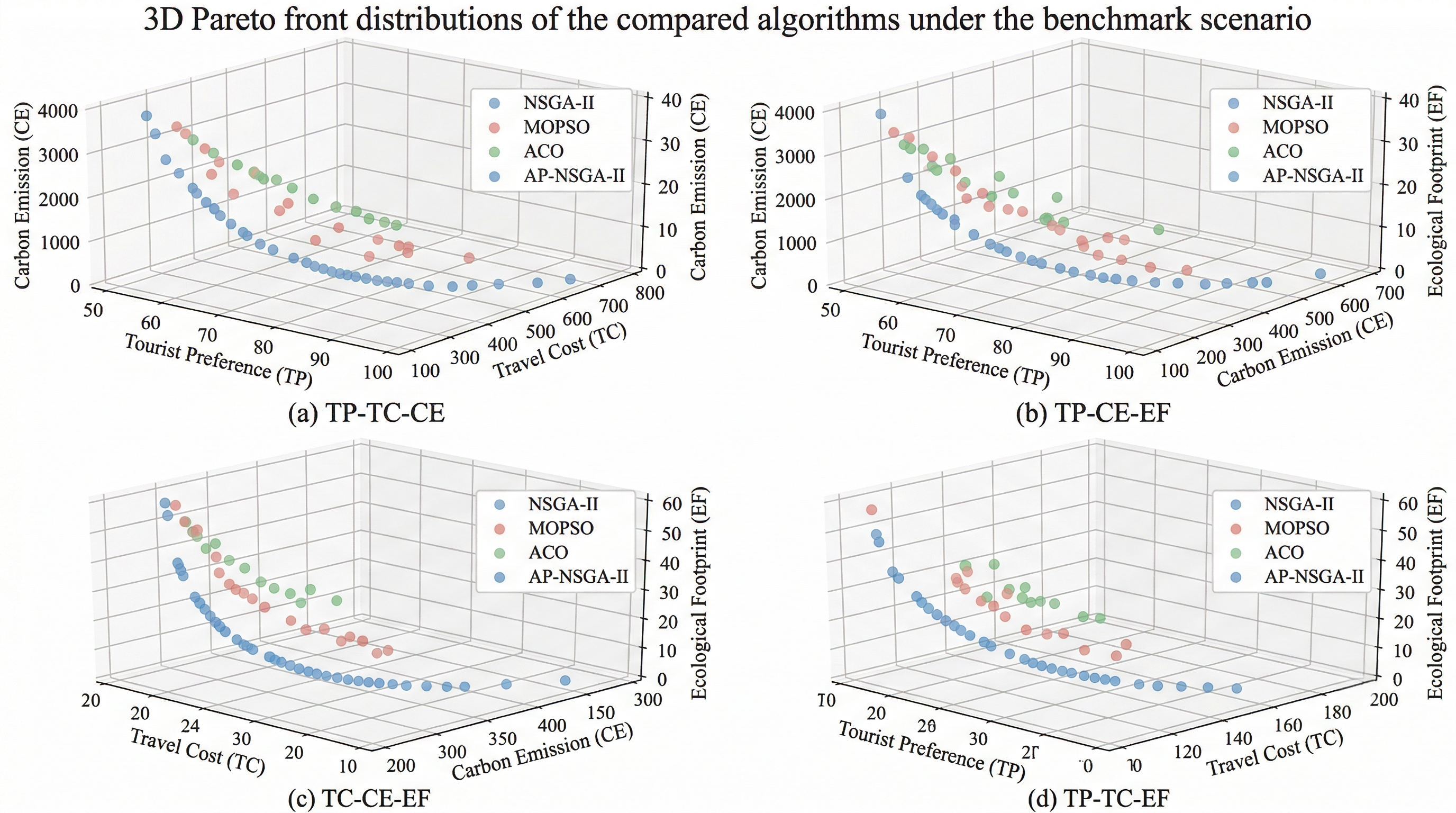
With the rapid growth of global tourism, carbon emissions and ecological pressures from tourism activities have emerged as major barriers to sustainable destination development. Traditional Tourist Trip Design Problems (TTDPs) typically focus on maximizing tourist satisfaction or minimizing travel time and costs, often overlooking deeper environmental impacts. Existing green tourism studies tend to rely on a single carbon emission indicator, neglecting broader environmental factors such as water use, land consumption, and biodiversity impacts. This has created a need for a systematic trip optimization framework that simultaneously considers both carbon emissions and ecological footprint. To address this gap, this study proposes a multi-objective sustainable tourist trip optimization model that integrates carbon emissions and ecological footprint as dual environmental constraints. The framework aims to balance tourist preferences, travel costs, and ecological impacts within a unified optimization model. At the algorithmic level, an Adaptive Penalty-based NSGA-II (AP-NSGA-II) is developed, combining an adaptive penalty mechanism with lightweight local improvement strategies for efficient solution of the multi-objective problem. A representative eco-tourism scenario featuring 40 Points of Interest (POIs) is used to validate the framework. The dataset combines publicly available geographic data, literature-based parameter settings, and standardized simulated tourist preference profiles to ensure reproducibility. Controlled simulations are conducted for tourist groups of different sizes. Using Pareto optimality theory and the Technique for Order of Preference by Similarity to Ideal Solution (TOPSIS), the model generates illustrative itineraries under various preference scenarios. Experimental results show that, compared with baseline algorithms such as traditional NSGA-II, MOPSO, and ACO, the proposed AP-NSGA-II achieves higher Hypervolume (HV) performance, more evenly distributed Pareto fronts, and itineraries that reduce carbon emissions and ecological footprint while maintaining comparable tourist satisfaction. Overall, this study provides a practical methodological reference for multi-objective tourist trip design, demonstrating that tourist experience and ecological protection can be integrated within a single optimization framework. The proposed model also serves as a reproducible decision-support tool for evaluating trade-offs among preference, cost, carbon emissions, and ecological footprint, offering guidance for future sustainable tourism planning.