Digital Twin Energy Hub Optimization for Climate- Resilient Net-Zero Cities: Landscape-Ecology Coupling and Multi-Energy Flow Coordinated Dispatch
Keywords:
Digital Twin, Energy Hub, Climate Resilience,Net-Zero City, Landscape-Ecology Coupling, Multi-Energy Flow Analysis, Scenario-Based AssessmentAbstract
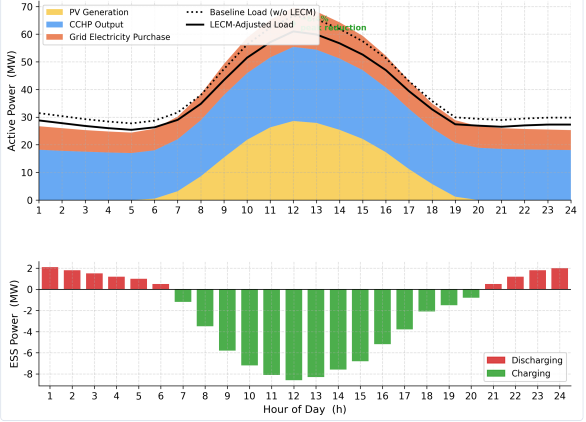
This study introduces a scenario-based analytical framework for planning climate-resilient, net-zero cities by linking landscape ecology with coordinated multi-energy system analysis. At the methodological level, it develops a simplified energy hub model that captures the interactions among electricity, heating, and gas systems. This model is embedded within a virtual environment inspired by digital twin concepts, allowing different scenarios to be compared in a clear and controlled way. To bring ecological factors into the analysis, the study incorporates key landscape indicators—such as vegetation carbon sequestration capacity, surface temperature regulation, and leaf area index—into a Landscape-Ecology Coupling Matrix (LECM). Rather than relying on costly real-time deployment or highly complex optimization models, the framework emphasizes transparent scenario comparisons to explore how these ecological elements influence system performance under varying climate conditions. Using representative annual data from a climate-sensitive urban context, the framework is applied to a system that includes distributed energy generation, combined cooling, heating and power (CCHP), energy storage, and green landscape infrastructure. The results indicate that, particularly under extreme climate scenarios, the integrated approach can help lower operating costs, reduce net carbon emissions, and ease peak cooling demand to some extent. Overall, this study offers a cross-disciplinary perspective by demonstrating how urban landscape considerations can be meaningfully incorporated into energy system planning and operation, contributing to more resilient and sustainable net-zero city development.