Adsorption Failure and Control Strategies of Hierarchical-Porous Biochar in Dynamic-Humidity Indoor Environments: A Mechanism-Directed Review and Adaptive Control Framework
Keywords:
hierarchical porous biochar, indoor air quality, water co-adsorption, volatile organic compounds, humidity-aware adsorption controlAbstract
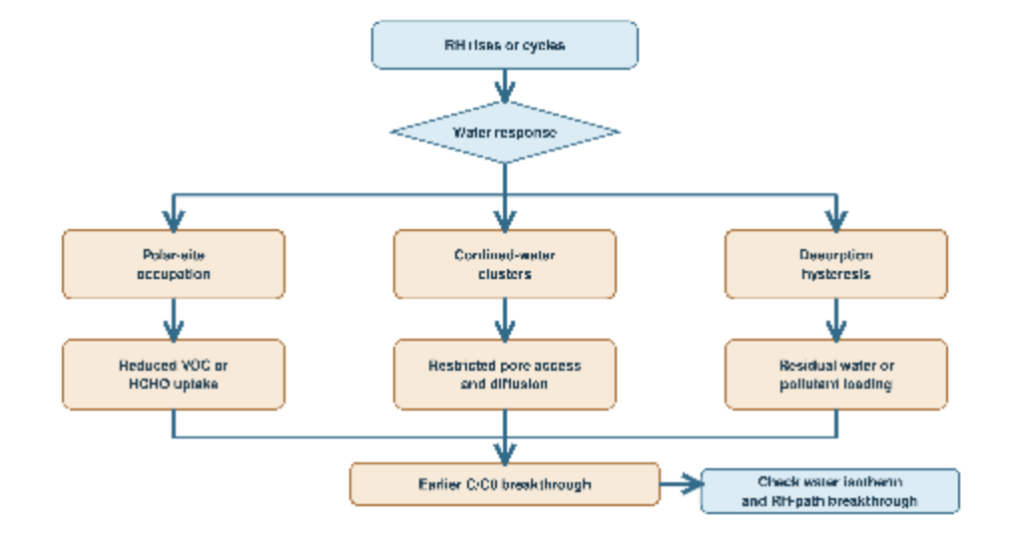
Indoor adsorption filters operate under relative-humidity (RH) trajectories rather than under a single dry-state condition. This distinction is particularly consequential for hierarchical-porous biochar because its high-affinity micropores and polar surface sites can also serve as loci for water adsorption. The resulting performance loss is often described simply as competitive adsorption, although recent evidence indicates three separable processes: water competition at polar binding sites, confined-water clustering that restricts pore access and intraparticle diffusion, and adsorption–desorption hysteresis that makes a bed’s prior humidity exposure part of its functional state. This review evaluates these processes for volatile organic compounds (VOCs) and formaldehyde (HCHO) in indoor-air-relevant carbon adsorbents, with emphasis on activated biochar and related activated carbons. It synthesises humid co-feed experiments, water-vapour isotherms, fixed-bed breakthrough studies, and routine pore and elemental characterisation published principally from 2020 onward. The evidence shows that pore hierarchy does not itself confer humidity tolerance: ultramicroporosity may maximise dry adsorption potential yet increase sensitivity to confined water, whereas mesopore connectivity can improve access to adsorption domains without independently guaranteeing humid capacity. Surface oxygen, nitrogen functionality and readily obtained surface properties exert conditional effects that depend on target polarity and whether removal is physical capture or reactive transformation. Building on this evidence, the paper proposes a humidity-aware evaluation protocol and a laboratory-scale decision framework that couples material design, RH-path testing, regeneration diagnostics, and sensor-informed operation. The central conclusion is that credible claims of indoor durability require dynamic, mixed-pollutant, cycling evidence with water-state characterisation; dry equilibrium capacity and Brunauer–Emmett–Teller surface area are insufficient proxies for humid service performance.