Green Clay-Based Functional Fillers Empowering Particleboards: A Synergistic Antibacterial–VOC Regulation Strategy for Healthy Indoor Living
关键词:
particleboard, montmorillonite, inorganic antibacterial filler, volatile organic compounds, healthy indoor摘要
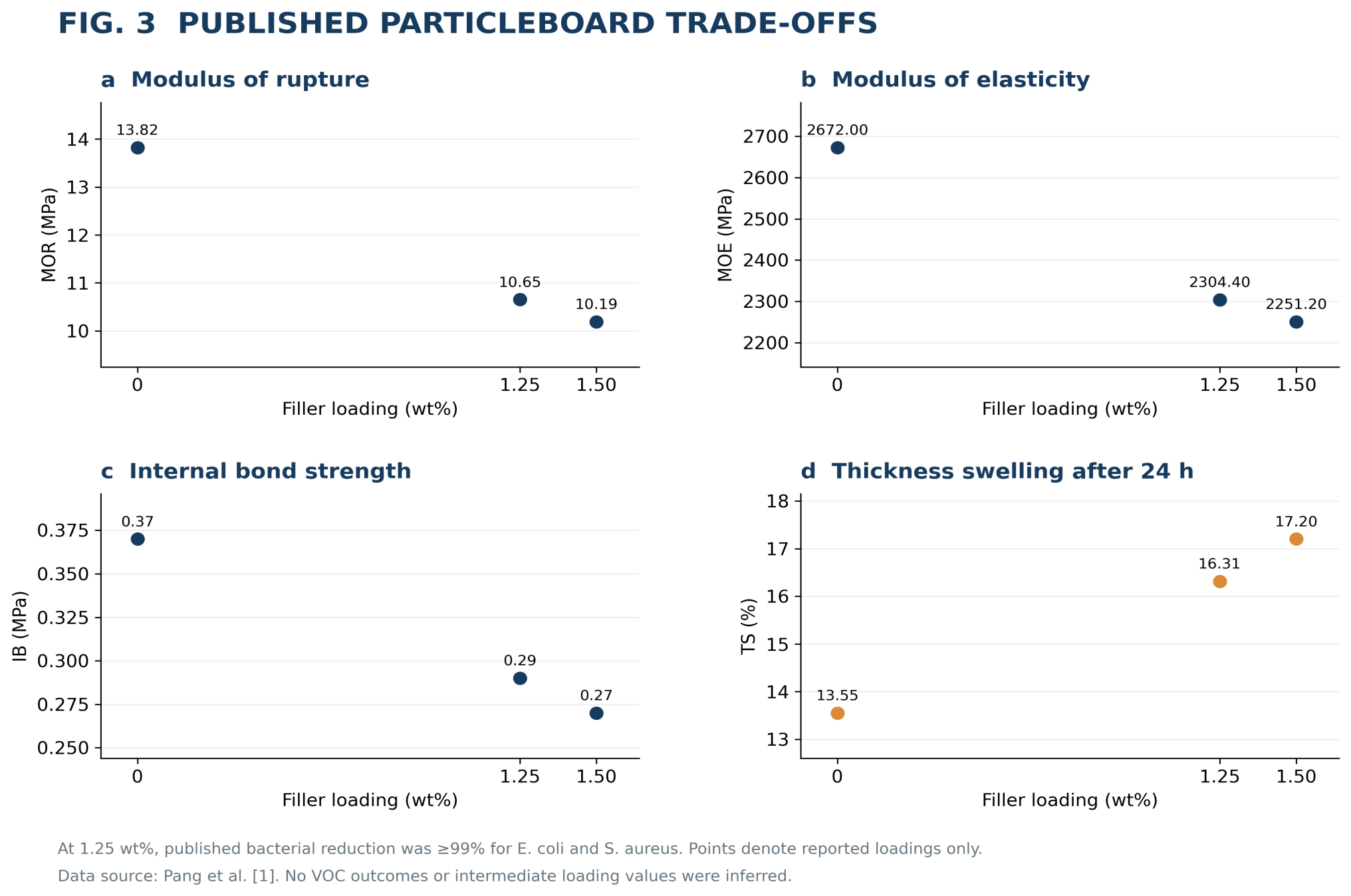
Particleboards are central to furniture and interior fit-out systems, yet their contribution to healthy indoor living is limited by two coupled material-level challenges: colonisation of moisture-exposed surfaces and the release of volatile organic compounds (VOCs) from wood, adhesive, and finishing constituents. This evidence-integrated design study develops a green clay-based functional-filler strategy that treats antimicrobial performance and VOC mitigation as coupled but independently verifiable outcomes. The strategy uses organo-modified montmorillonite as a carrier for Cu²⁺ and ZnO antibacterial sites while proposing the clay microenvironment as a potential adsorption domain for formaldehyde and broader VOCs. Published particleboard evidence demonstrates that a Cu²⁺/ZnO@MMT-O filler achieved a 99% antibacterial rate against both Escherichia coli and Staphylococcus aureus at 1.25 wt% loading, while retaining a modulus of rupture of 10.65 MPa, a modulus of elasticity of 2304.40 MPa, an internal bond strength of 0.29 MPa, and 24 h thickness swelling of 16.31% [1]. These published values establish antimicrobial feasibility and illuminate an interfacial trade-off, but they do not establish VOC reduction. Accordingly, the present manuscript makes no claim of measured VOC mitigation. It outlines an accessible preliminary comparison using a small laboratory-built enclosure and basic descriptive statistics; formal ISO 16000-9 chamber testing remains a subsequent validation step. X-ray diffraction and infrared spectroscopy suffice for the initial filler assessment, while advanced imaging and precise surface-area measurements are optional follow-up analyses. The contribution is a transparent material-design and evaluation framework: mineral-supported antimicrobial action is evidenced, whereas a defensible healthy-indoor claim requires controlled VOC kinetics, mechanical retention, and release safety. This framing converts a single-function additive into a testable platform for healthier wood composites.