Industrial-Current-Density Direct Seawater Electrolysis: Coupled Mechanisms of Activity, Selectivity, and Stability — A Literature-Constrained Multiscale Design-Space Study
Keywords:
direct seawater electrolysis, industrial current density, oxygen evolution selectivity, chloride corrosion, microenvironment engineering, multiscale electrode designAbstract
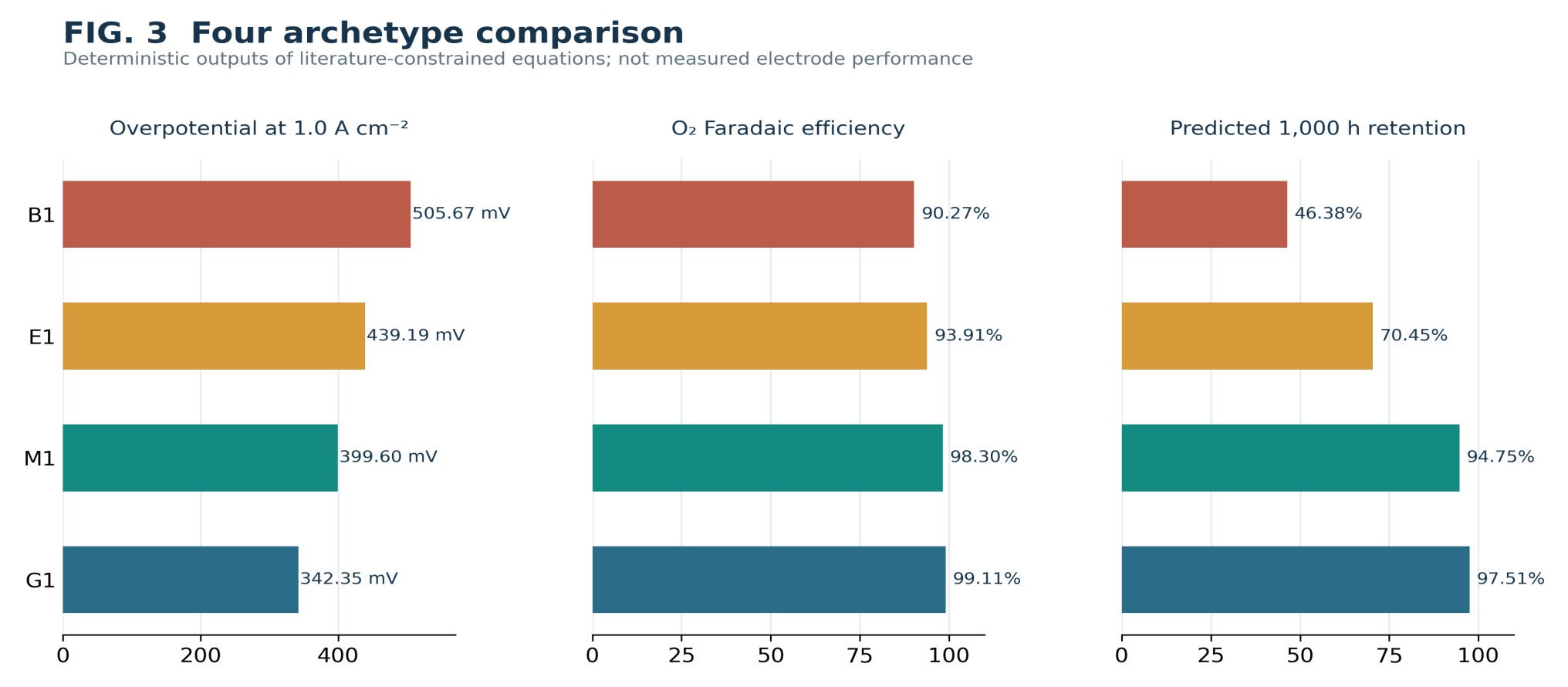
Why: Direct seawater electrolysis could simplify water handling in saline and offshore settings, but activity at high current is inseparable from oxygen/chlorine selectivity, halide corrosion, alkaline-earth scaling, gas transport, and system architecture. Comparisons are further distorted when raw neutral seawater, alkaline seawater, asymmetric feeds, ion-separated systems, and desalination-coupled electrolysis are treated as equivalent. How: We developed a literature-constrained phenomenological model spanning six normalized electrode descriptors: intrinsic kinetics, site exposure, chloride exclusion, passivation robustness, transport efficiency, and microenvironment control. Four representative archetypes were considered: an unprotected oxyhydroxide, an electronic heterojunction, an anion-regulated microenvironment, and a gradient-integrated electrode. With what: The evidence base comprised 38 references from 2020–2026, condition-qualified benchmarks, and explicit equations for activity, oxygen selectivity, a hypochlorite-yield proxy, and degradation. Descriptor values for the four archetypes were substituted into the equations, with uncertainty and sensitivity assessed qualitatively from their structure. What: The deterministic theoretical outputs for B1, E1, M1, and G1 respectively give overpotentials of 505.67, 439.19, 399.60, and 342.35 mV at 1.0 A cm−2; oxygen Faradaic efficiencies of 90.27, 93.91, 98.30, and 99.11%; and predicted 1,000 h retentions of 46.38, 70.45, 94.75, and 97.51%. G1 gives an activity–selectivity–stability score of 91.42. The equations indicate that intrinsic kinetics strongly affects activity, chloride exclusion affects selectivity, and chloride exclusion together with passivation affects stability. So what: The results are theoretical inferences derived from four representative archetypes under literature-constrained model equations; large-scale design-space scanning remains a direction for future research. Industrial-current electrodes should spatially integrate catalytic kinetics, controlled ion access, chemically robust passivation, and bubble/precipitate transport. These hypotheses require experimental validation and are not certified device specifications.