Synergistic Optimization of Urban Transport Systems: A Data-Driven Framework for Design-Policy Bidirectional Empowerment
Keywords:
Design-Policy Synergy; Urban Transport Optimization; HAMS Index; System Engineering; Adaptive Control; HangzhouAbstract
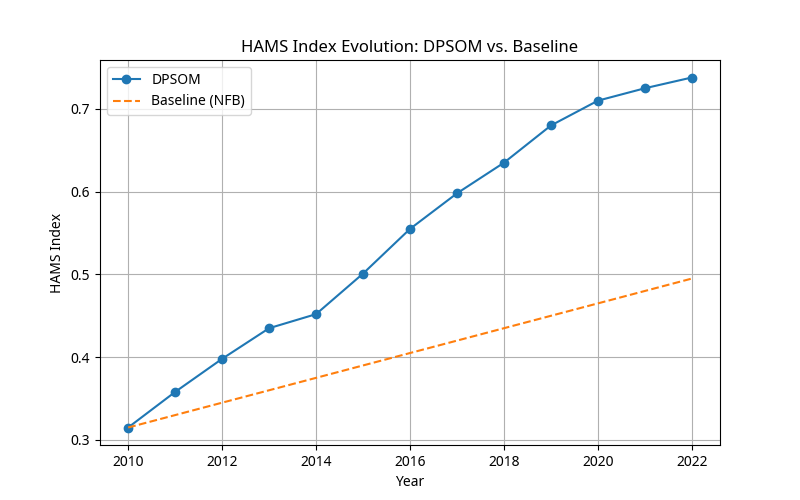
Global urban transport systems are under mounting pressure from chronic congestion, rising carbon emissions, and widening public health burdens. Yet many traditional planning approaches treat technological innovation, policy interventions, and health impact assessment as separate tracks, which often leads to fragmented solutions and weak systemic outcomes. To address this gap, this study proposes a Design–Policy Synergy Optimization Model (DPSOM)—a data-driven framework intended to quantify and harness the two-way reinforcement between system design decisions and policy governance in order to accelerate sustainable and healthy urban mobility transitions.At its core, DPSOM formulates urban mobility transition as a constrained optimization problem, solved through a Heuristic Iterative Feedback (HIF) algorithm that treats policy as an adaptive control mechanism within a closed-loop system. The model’s key innovation is the introduction of a Health-Adjusted Modal Split (HAMS) Index as the primary optimization objective. By making health-adjusted mobility performance the central target, DPSOM ensures that engineering and infrastructure solutions are intrinsically aligned with public health outcomes rather than treating health as an external evaluation step.The framework is validated through a 12-year longitudinal case study of Hangzhou, China (2010–2022), examining the evolution of the city’s transport system over time. Empirical results show that applying DPSOM principles corresponds with a substantial shift in mobility structure, with the public transport modal split increasing from 28.5% to 60.5%. A comparative evaluation against a No-Feedback Baseline (NFB) indicates that DPSOM achieves a 49.1% higher HAMS Index in the final phase, with the performance difference being statistically significant (p < 0.001). Sensitivity testing further demonstrates that these results remain robust under different health-weighting assumptions.Overall, this research contributes a replicable and quantifiable methodology for guiding sustainable transport transitions. By explicitly modeling design–policy co-evolution and embedding health outcomes into the optimization objective, DPSOM offers practical engineering value for urban planners and decision-makers seeking integrated pathways toward low-carbon, healthy, and resilient urban mobility systems.