Designing Closed-Loop Energy Supply Chains under Lean Economy: Co-optimization of Resource Efficiency and Social Adaptability
Keywords:
losed-loop supply chain; Lean economy; Integrated energy system; Multi-objective optimization; Social adaptability; Circular economyAbstract
Against the backdrop of the global energy transition and the advancement of “dual carbon” goals, building energy supply chain systems that are both efficient and sustainable has become a shared priority for researchers and industry practitioners alike. In reality, however, many existing energy supply chains still struggle with low resource utilization, notable environmental side effects, and increasingly complex social challenges. Much of the current research has concentrated on improving single objectives—such as cost reduction or environmental performance—while paying limited attention to how resource efficiency and social adaptability can be developed in a coordinated manner under the framework of a Lean Economy. This has left an important gap in the literature.
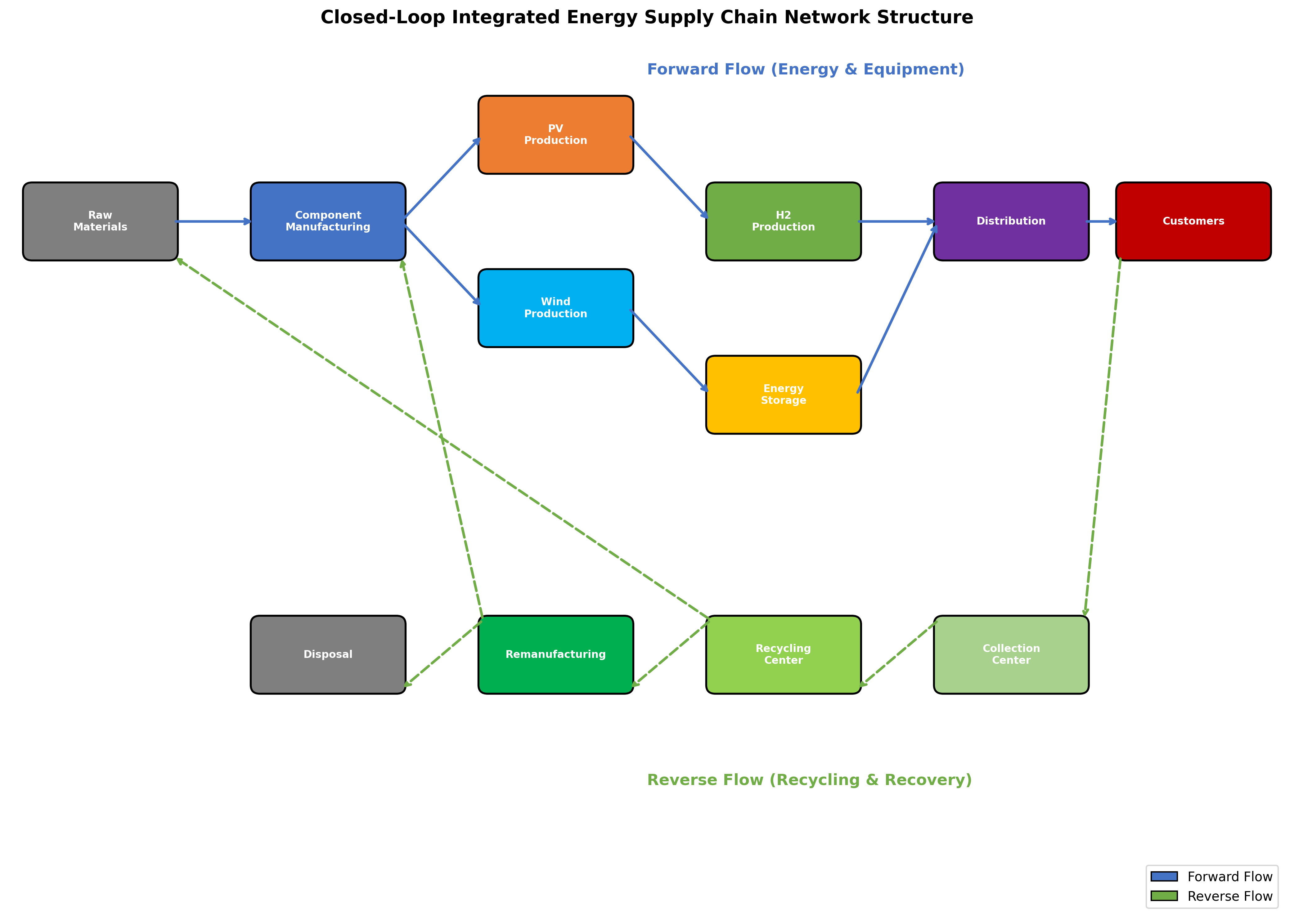
To address this issue, this study develops a closed-loop energy supply chain network optimization model that incorporates multiple objectives, multiple time periods, and multiple energy types, including photovoltaic power, wind energy, hydrogen, and energy storage. The model is designed to explore how lean principles can be innovatively applied within modern energy systems. The Augmented Epsilon-Constraint (AUGMECON) method is used to solve the model, and a major industrial province in China is selected as a representative case study. The model’s feasibility and practicality are verified using publicly available official statistics and open-access industry data.
The results show clear nonlinear trade-offs among the three core objectives: economic cost, resource efficiency, and social adaptability. Quantitative analysis indicates that a systematic application of lean strategies can reduce total supply chain costs by about 15% while increasing the recycling rate of key resources by more than 8%. At the same time, the findings suggest that certain lean measures may temporarily reduce employment in traditional energy sectors. This highlights the need for policymakers to introduce effective cushioning measures, such as targeted skills retraining programs and strengthened social security policies.
Overall, this research provides a comprehensive decision-support framework for energy enterprises and public authorities, helping them balance energy security, economic performance, resource conservation, and social equity. It offers both strong theoretical contributions and practical insights for accelerating the transition toward a lean, circular, and socially adaptive future energy system.