Sustainable Adaptive Reuse of Industrial Heritage for Urban Resilience: A Multi-objective Collaborative Optimisation Framework and Place-Value Enhancement Mechanism
关键词:
Industrial heritage, Adaptive reuse, Urban resilience, Scenario-based evaluation, Entropy-Weight TOPSIS, Place value, Embodied carbon摘要
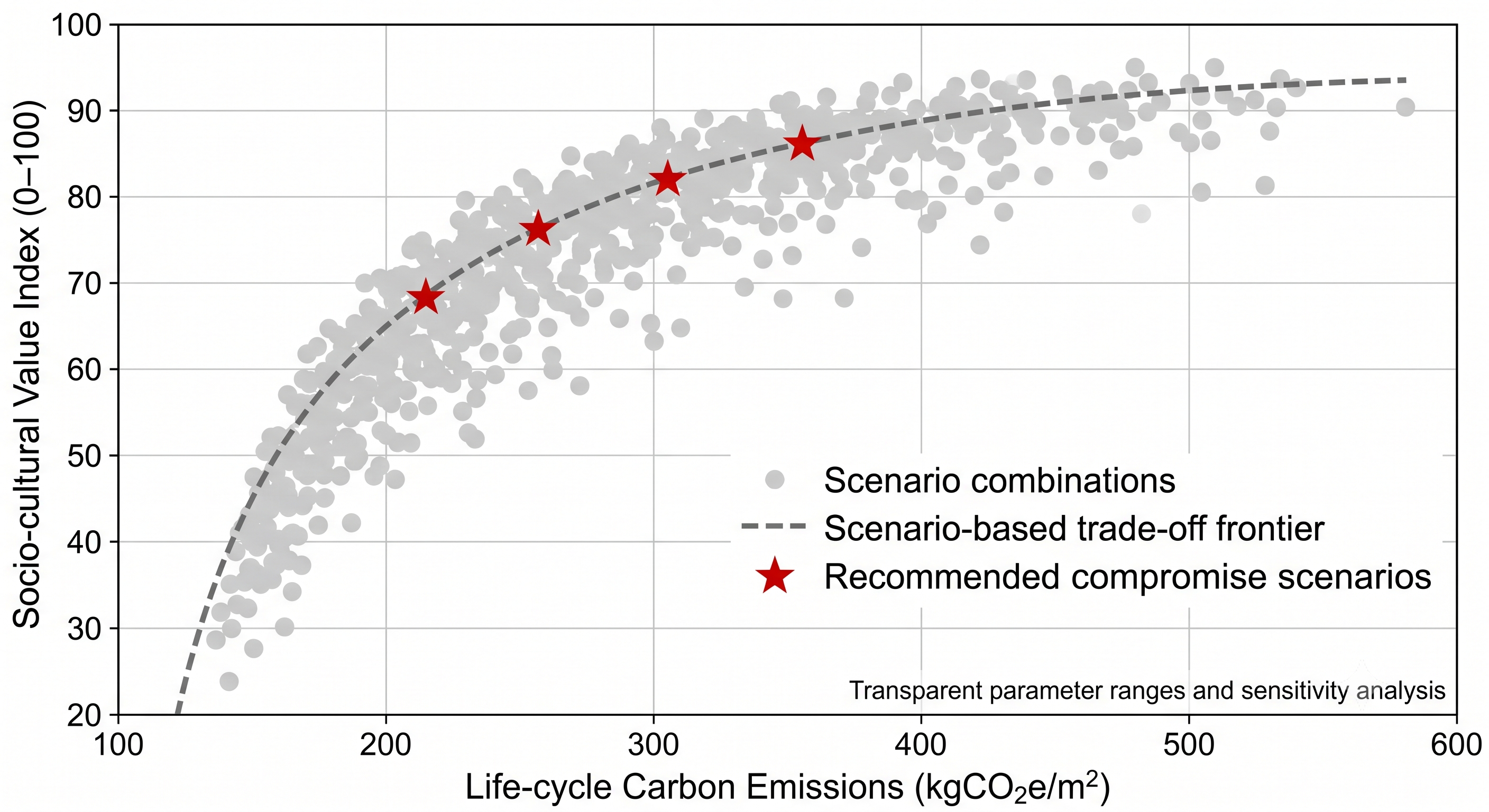
The post-industrial cities are experiencing serious resilience challenges due to globalization, deindustrialization, and climate change. The adaptive reuse of industrial heritage as a critical carrier of urban memory and spatial structure is not only about cultural conservation but also one of the most important ways of improving urban resilience and attaining sustainable development. Nonetheless, there are examples of modern adaptive reuse practices that tend to extreme ends of the scale, either being limited to commercialisation only or static preservation, ignoring social equity, i.e., the displacement of original residents in the process of gentrification, and environmental costs, i.e., the high amount of embodied carbon emissions. In order to fill this gap, this paper suggests that a low-cost and reproducible decision-making and assessment framework can be adopted to combine multi-criteria analysis with place-value improvement. First, an evaluation indicator system of resilience-oriented reuse is developed based on the Entropy-Weight TOPSIS approach that considers five dimensions: economic, social, environmental, infrastructure and institutional resilience. Second, rather than depending on costly field experimentation or parameter-intensive algorithm optimization, a clear scenario-based trade-off analysis is applied to assess carbon impacts of life cycles and socio-cultural value across different retrofit alternatives. Lastly, the discussion of how social innovation facilitates territorial innovation is explored by combining the Analytic Hierarchy Process and SWOT into A'WOT and by simplifying spatial and governance analysis. The case-based application shows that the overall reuse plan has a better-balanced performance than the commercial-development and ecological-conservation plans, and it is possible to enhance the environmental and social resilience by keeping the existing buildings, increasing the number of people involved in the process, and adopting inclusive governance. This paper gives a practical and repeatable decision-making instrument of industrial heritage conservation in the context of everyday research and planning, providing theoretical support that balances environmental advantages and social justice in urban regeneration and resiliency construction.