Sustainable Mobility Guarantee under the 15-Minute City Concept: A Framework for Urban Travel Equity and Spatial Optimization
关键词:
15-Minute City, Sustainable Mobility Guarantee, Travel Equity, Spatial Optimization, Accessibility Modeling摘要
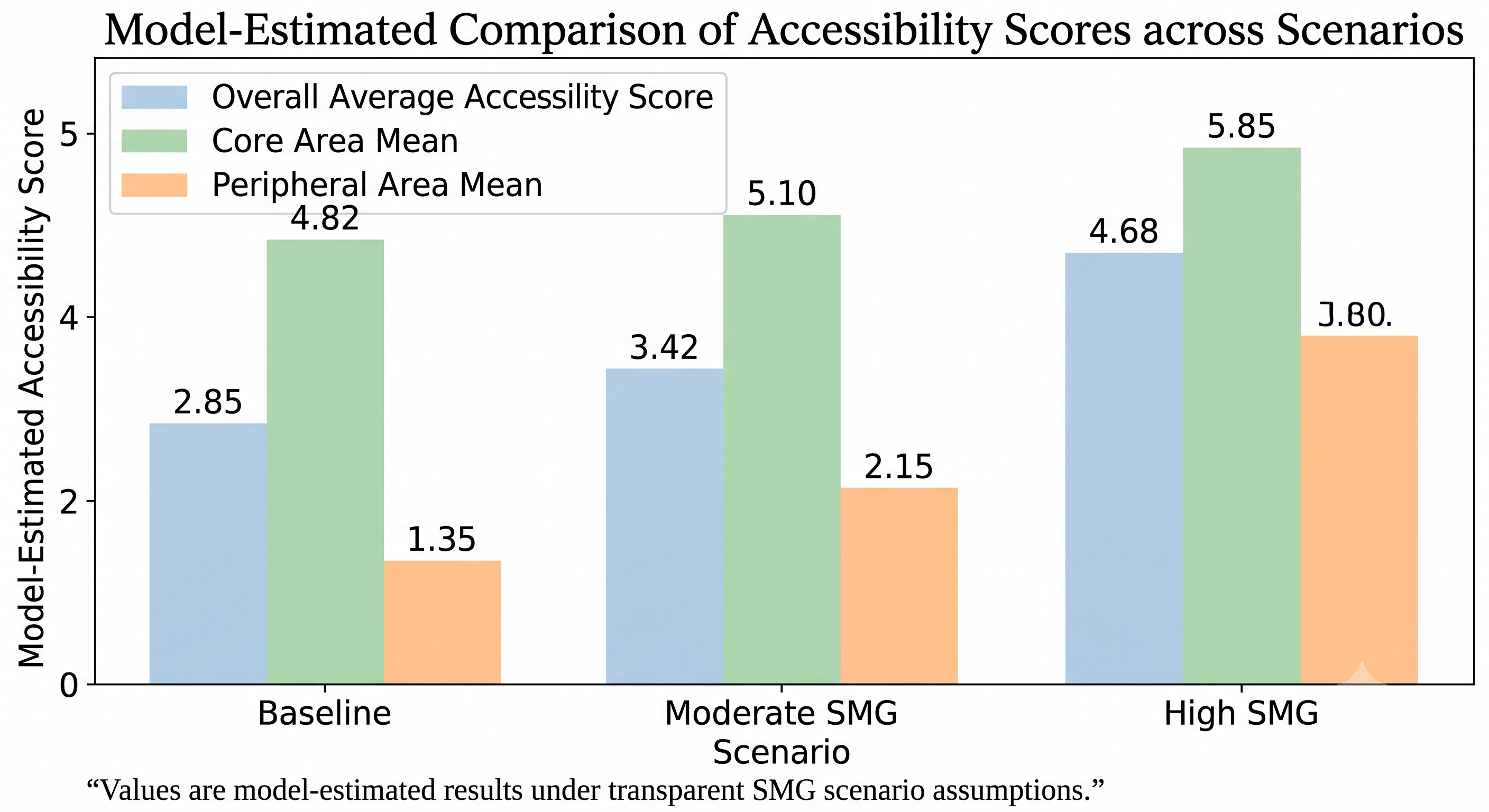
In the context of worldwide climate change and the spread of cities, the idea of the "15-Minute City" has become very popular among scholars and policymakers as an important planning paradigm to support the localization of daily essential services and low carbon travel. Nevertheless, current studies mostly deal with high-density accessibility analysis on urban cores, frequently failing to consider the travel requirements of marginal regions and disadvantaged populations. Such an omission leads to not translating the spatial notion of proximity into the social notion of travel equity. Old-fashioned transportation planning does not have a standardized guarantee system that would combine environmental restrictions with social inclusion. Based on the idea of the Sustainable Mobility Guarantee (SMG), this paper suggests a spatial optimization model that incorporates accessibility modeling, spatial equity measures, and multi-modal transport synergy. Through the creation of a multi-modal accessibility model that is quantifiable in terms of spatial units, which considers walking, cycling, public transit, and inexpensive micro-circulation feeder assumptions, we quantify the gap in travel equity between various spatial units. This paper uses the Two-Step Floating Catchment Area (2SFCA) method and the Gini Index to measure the spatial equity of existing service facilities based on reproducible urban data sets, such as open POI records, OpenStreetMap road networks, and publicly available transit stop and schedule information, in a typical peripheral built-up area in Shanghai as a demonstration scenario. After that, three guarantee scenarios with varying degrees of low-cost networks and service modifications are simulated with transparent and repeatable parameter assumptions. It is found that the mere reduction in physical distance will not lead to genuine travel equity: currently, the Gini index in peripheral areas is at 0.42, which means considerable spatial deprivation. With the improved guarantee scenario under the simulated multi-modal SMG mechanism, the total regional accessibility Gini index decreases to 0.28, which implies that the service gap between core and peripheral groups narrows significantly within the given modeling assumption. The present work reinterprets the idea of the 15-Minute City as a spatial proximity concept and turns it into a reproducible and low-cost transportation guarantee evaluation tool, offering theoretical background and quantitative decision-making assistance to urban planners to optimize their resource use and improve the travel rights of vulnerable populations when budgeting.