Constructing an Inclusive Sustainable Mobility Guarantee: A Synergistic Mechanism of Transport Equity, Green Travel, and Social Wellbeing
关键词:
Sustainable Mobility Guarantee, Transport Equity, Social Wellbeing, Reproducible Assessment, Green Travel, Inclusive Design摘要
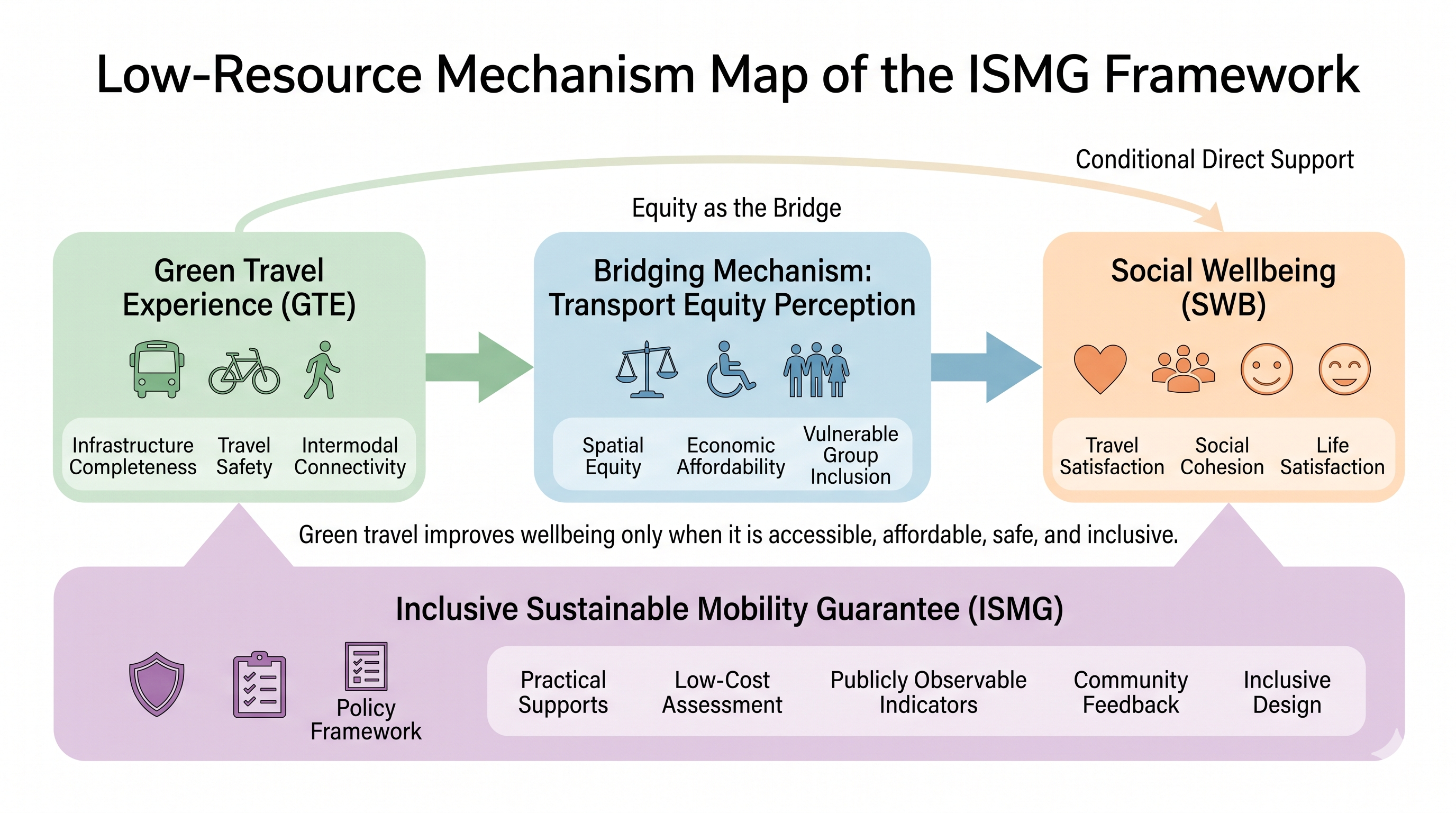
Introduction and Problem Statement The transition towards sustainable mobility has become one of the most pressing issues in the urban development due to the dual threats of global climate change and urbanization. Nonetheless, current transport policies have been inclined more on carbon emission reduction and building of infrastructure which sometimes ignores the mobility exclusion and spatial inequality which vulnerable groups experience during this transition. At present, there is no systematic framework that incorporates transport equity, green travel, and social wellbeing. This research suggests the idea of the Inclusive Sustainable Mobility Guarantee (ISMG) and develops a synergistic model of Transport Equity- Green Travel-Social Wellbeing with respect to design innovation and interdisciplinary approaches. The study uses a low resource analysis strategy that does not depend on high cost field experimentation or large scale modeling that is hard to reproduce by using literature synthesis, indicator mapping and clear scenario-based interpretation. Implementation: This paper presents a reproducible assessment method of high-density urban environments through the combination of the results of current transport equity, green travel, and wellbeing researches and observable public indicators of the daily mobility conditions. The procedure is based on the usual planning and design problems and can be applied without proprietary spatial data, a specific GIS extraction process, or major primary surveys. Main Results: The findings of the analysis indicate that the promotion of green travel, such as use of public transport and active mobility, is not necessarily associated with improvement in social welfare. It has a positive impact when transport services are seen as spatially fair, economically accessible and equitable to vulnerable people. Low-cost interventions like barrier-free walking environment, safer transfer spaces, targeted fare support, and accessibility improvement at the neighbourhood level can be used within the ISMG framework to lessen mobility exclusion among low-income and elderly individuals. Significance and Value: The paper develops the conceptual limits of the customary Sustainable Mobility Guarantee, offering a theoretical foundation to the paradigm shift in urban transport planning to be oriented towards human well-being rather than efficiency. Moreover, it gives policy makers and designers a clear and simple evaluative scheme to use when developing transportation policies that aim at reducing emissions but at the same time promote social inclusion.