From Static Reachability to Dynamic Transport Equity: A Multi-Source Spatiotemporal Framework for Identifying Supply–Demand Mismatches
关键词:
dynamic transit accessibility, transport equity, supply-demand mismatch, GTFS, hourly ridership, spatiotemporal analysis摘要
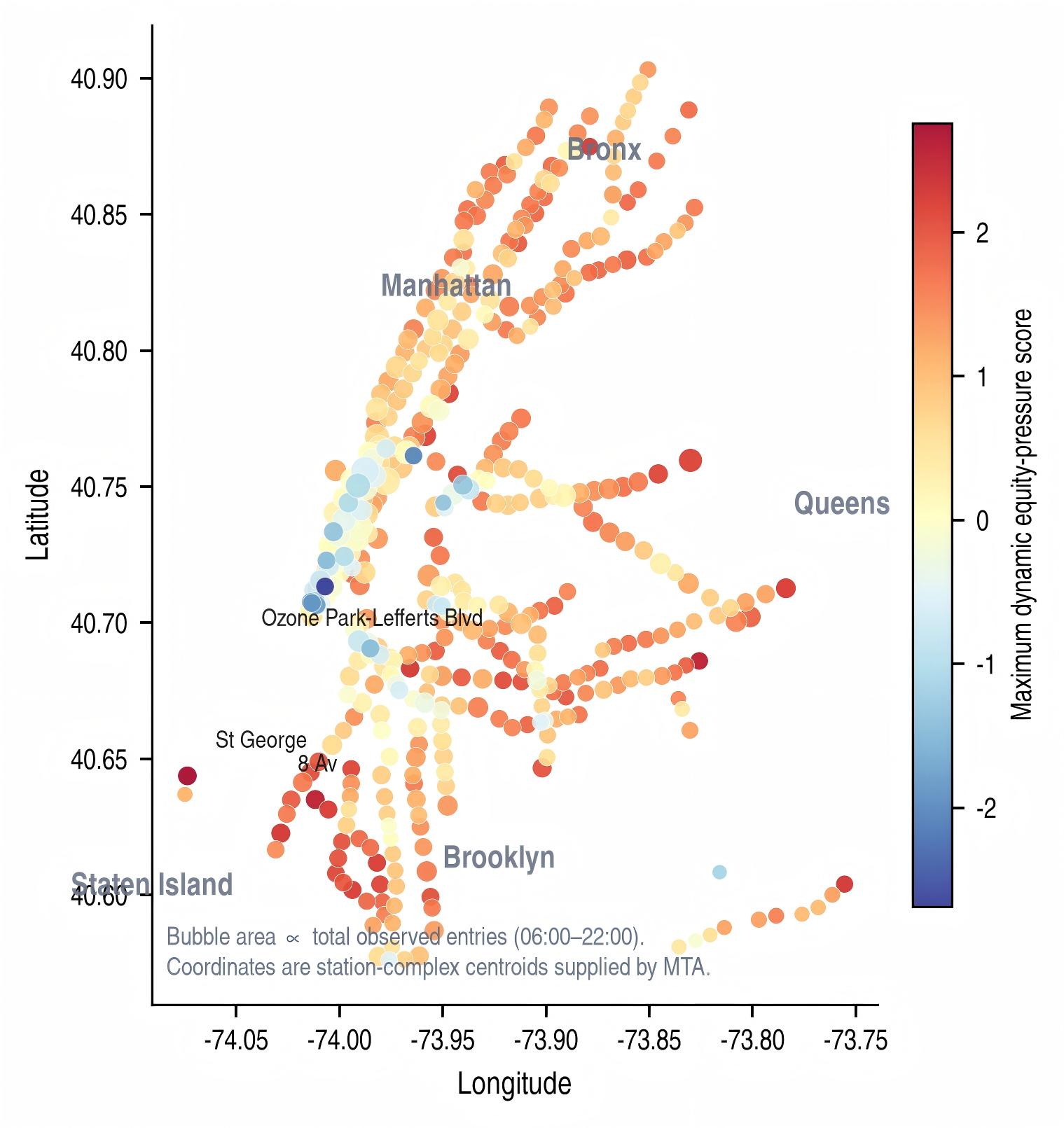
Transport equity is frequently assessed through static measures of network proximity, stop coverage, or all-day accessibility. These measures remain useful, but they cannot reveal whether scheduled service is aligned with the timing and social distribution of observed demand. This paper develops a reproducible dynamic transport-equity framework that integrates schedule-based supply, hourly observed station entries, and a demand-side equity signal to identify time-specific supply–demand mismatches. The framework is demonstrated with a synchronised New York City Subway case study, combining the official General Transit Feed Specification (GTFS) schedule valid on 15 September 2026, the Metropolitan Transportation Authority (MTA) hourly ridership dataset, station-complex coordinates, and the share of entries paid with the MTA Fair Fare category. Supply was represented by scheduled platform stop-events within a 250-m station-complex catchment; demand was represented by station-complex entries in each clock hour; and equity pressure was defined as the difference between standardised log demand and standardised log scheduled supply plus a transparent Fair Fare weighting term. The resulting panel contained 7,249 station-hour observations across 427 spatially matched station complexes from 06:00 to 22:00. Static daily and dynamic equity-pressure indicators were positively associated (Spearman’s ρ = 0.708, p < 0.001), yet the static indicator failed to identify 49 of 107 dynamic top-quartile priority stations. Dynamic priorities were disproportionately located in Brooklyn, Queens, and the Bronx, while several high-pressure locations occurred in early-morning, morning-peak, or mid-afternoon windows that daily aggregation obscured. Rank ordering remained substantively stable when the equity weight varied from 0 to 0.50 (ρ = 0.939–0.963 relative to the baseline). The study contributes a transparent bridge between static accessibility and operationally meaningful equity diagnostics. It also demonstrates that a station-hour framework can direct attention from generic coverage expansion toward targeted frequency, timing, transfer, and affordability interventions. The indicator is not a measure of vehicle crowding or a complete definition of justice; rather, it is a reproducible screening instrument whose normative assumptions and data limitations are explicit.