Participatory Scenario Analysis and Rural Sustainable Innovation: A Mixed-Methods Study of Multi-Stakeholder Policy Co-Creation
关键词:
participatory scenario analysis, rural sustainable innovation, policy co-creation, mixed methods, multi-criteria decision analysis摘要
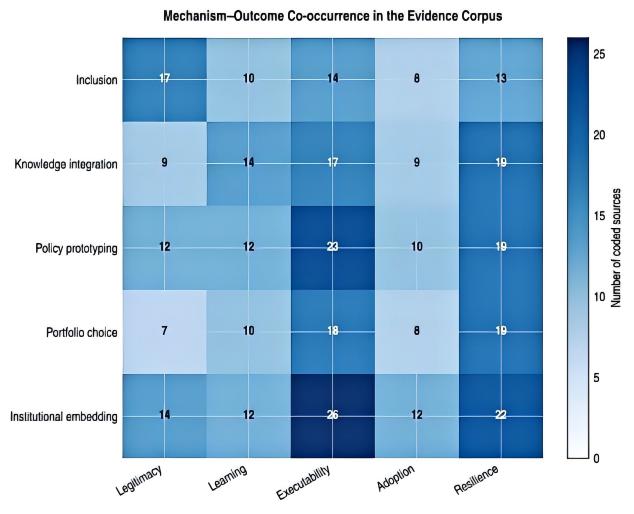
Rural sustainable innovation is shaped simultaneously by climate risk, digital divides, organizational fragmentation, and conflicts among values. Conventional linear consultation and static strengths–weaknesses analysis provide limited insight into how diverse actors jointly define problems, compare alternative futures, and convert agreement into executable policy. This study advances a scenario–prototype–portfolio–feedback framework for policy co-creation and examines its evidentiary basis through a sequential mixed-methods synthesis. The corpus comprises 36 sources published from 2021 to 2026 and verified through publishers, digital object identifiers, or official government websites; 33 are peer-reviewed articles. First, a quantitative evidence map structurally coded topics, methods, regions, five mechanisms, and five outcomes. Second, a qualitative thematic synthesis identified relationships among inclusion, knowledge integration, policy prototyping, portfolio selection, and institutional embedding. Third, policy-tool priorities were calculated using four criteria—evidence coverage, geographic breadth, implementation depth, and risk control—and tested under four weighting schemes. Institutional embedding and executability co-occurred in 26 sources, policy prototyping and executability in 23, and both knowledge integration and portfolio selection with resilience in 19. Participatory monitoring and feedback ranked first under all four weighting schemes, with scores from 84.0 to 87.9. Farmer data rights and governance, followed by inclusive access and capacity building, ranked second and third under balanced weights. The central value of participation lies not in increasing meeting attendance, but in establishing traceable knowledge translation, allocation of responsibility, rights protection, and iterative learning. The study reframes participatory scenario analysis from a visioning technique into a design infrastructure and offers a reusable co-creation protocol for policy portfolios concerning digital rural development, climate adaptation, and agricultural socialized services in Chinese counties.