Regime Destabilization and System Innovation: A Pathway for Sustainable Transportation Engineering Transformation Based on Design Criticism
关键词:
Sustainability Transitions; Regime Destabilization; Design Criticism; System Innovation; Smart Mobility; Multi-Level Perspective (MLP)摘要
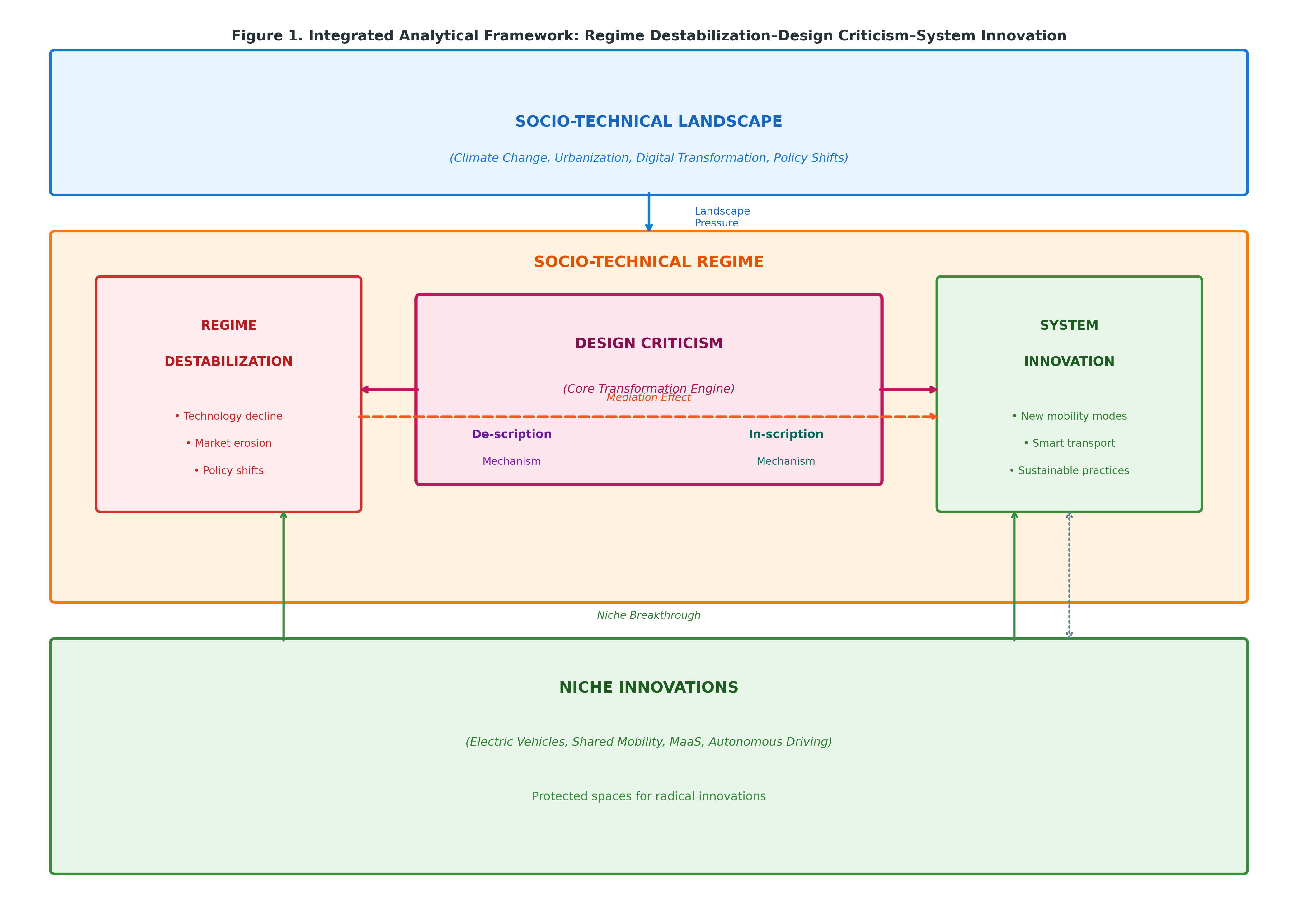
Global transportation systems are facing severe sustainability challenges posed by carbon emissions, traffic congestion, and resource depletion. Existing research predominantly seeks solutions from the perspectives of technological innovation or policy-making, largely overlooking the critical role that design criticism can play in destabilizing existing institutional foundations and fostering systemic innovation. A systematic framework that deeply integrates design theory with transportation engineering practice is particularly lacking. This study aims to fill this theoretical gap by constructing an integrated analytical framework—a trinity of “Regime Destabilization–Design Criticism–System Innovation”—by synthesizing the Multi-Level Perspective (MLP), regime destabilization theory, and design criticism theory. Employing a mixed-methods approach, this research investigates the smart mobility transitions in China’s three core urban agglomerations (Beijing-Tianjin-Hebei, Yangtze River Delta, and Guangdong-Hong Kong-Macao Greater Bay Area). It systematically collects and analyzes relevant policy documents, transportation big data, and typical design practice cases from 2018 to 2024, utilizing Computer-Assisted Qualitative Data Analysis Software (CAQDAS) and statistical models for in-depth data processing. The core findings reveal that design criticism, through its “de-scription” mechanism, can effectively deconstruct and destabilize the traditional, private car-centric transportation regime. Concurrently, through its “in-scription” mechanism, it promotes an innovative transition towards a multi-modal, integrated smart mobility system. Empirical results demonstrate a significant positive correlation between the intensity of design criticism and the degree of regime destabilization (r = 0.76, p < 0.001), which is closely associated with a 42.3% improvement in system innovation effectiveness. This study not only provides a novel design perspective for sustainability transitions theory but also offers a transformative pathway with both theoretical depth and practical value for paradigm shifts in the field of transportation engineering and related policy formulation, highlighting the crucial catalytic role of design criticism.