Design Innovation of Campus Climate-Neutral Energy Systems: From Technology Integration to Economic Optimization
关键词:
Climate Neutrality; Campus Energy System; Technology Integration; Economic Optimization; Mixed-Integer Linear Programming摘要
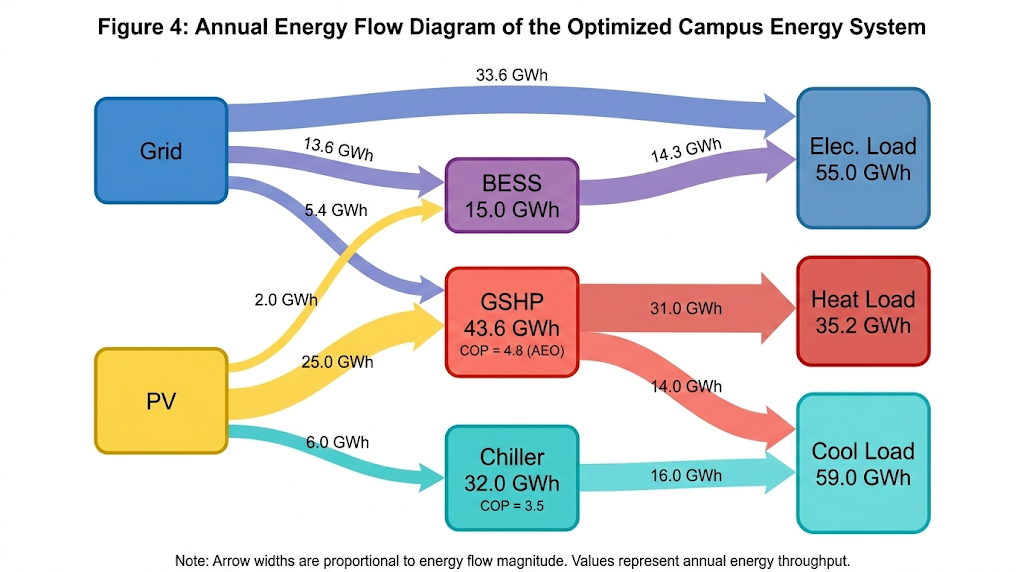
As the world accelerates its shift toward carbon neutrality, universities—major energy consumers and influential social leaders—are grappling with unclear strategies for transforming their energy systems in a greener direction. In response, this study introduces an economically driven, multi-period optimization model designed specifically for campus integrated energy systems. Built on a Mixed-Integer Linear Programming (MILP) framework, the model incorporates a range of technologies, including photovoltaic power generation, ground- and air-source heat pumps, electrochemical energy storage, and thermal storage tanks. Using a representative university in China’s Yangtze River Delta as a case study, the research identifies the most cost-effective combination of technologies and operational strategies to achieve climate neutrality. The findings show that deploying ground source heat pumps to handle base heating demands, alongside large-scale solar photovoltaics and energy storage systems, offers the most economically practical solution. Compared with traditional energy setups, the optimized system can cut Scope 1 and Scope 2 carbon emissions by more than 85%. Under projected grid decarbonization trends and tiered carbon pricing policies, the campus could realistically reach carbon neutrality by around 2045. Overall, this study delivers a practical decision-making framework that balances technical feasibility with economic efficiency, offering valuable guidance for university energy planning in China and other regions with similar climate conditions.