A Study on the Indoor Environmental Quality-Driven Synergistic Design Method for Building Carbon and Health Performance
Keywords:
Indoor Environmental Quality; Building Carbon Emissions; Healthy Building; Synergistic Design; Multi-Objective OptimizationAbstract
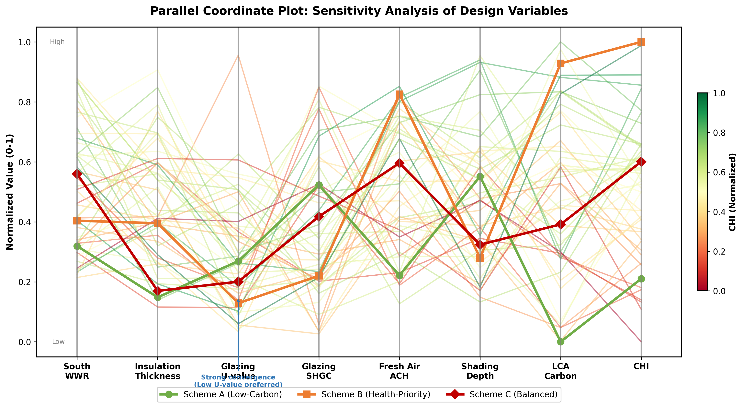
Amid the dual pressures on the construction industry to address climate change and safeguard occupant health, enhancing Indoor Environmental Quality (IEQ) often entails higher consumption of building materials and energy, thereby increasing the building's life-cycle carbon emissions and creating a significant trade-off. Existing research predominantly focuses on either energy conservation or health in isolation, lacking a systematic method for synergistically optimizing carbon and health performance during the early design stages. This study aims to fill this gap by proposing an IEQ-driven synergistic design method for building carbon and health performance. The method establishes an early-stage design evaluation framework that combines building performance analysis with multi-scheme comparative assessment to support coordinated decision-making on carbon and health performance. Through a case study of a typical office building, the proposed method was applied by considering key design variables, such as window-to-wall ratio, envelope thermal performance, and ventilation strategy, and by evaluating their impacts on life-cycle carbon performance and indoor environmental quality through a comprehensive assessment framework informed by existing healthy building standards. The results indicate that the method can help identify design schemes with improved health-related indoor environmental performance while maintaining carbon performance within an acceptable range. The case analysis suggests that appropriate combinations of envelope and ventilation parameters may support a better balance between carbon reduction and occupant health needs in early-stage design. This research provides architects and engineers with a practical tool for quantitative decision-making and for balancing building carbon emissions with occupant health needs in the early design stages. It promotes a paradigm shift from "energy-efficient buildings" to "sustainable healthy buildings" and offers significant theoretical and practical guidance for achieving the national goals of "dual carbon" and "Healthy China."